Monthly Archives: April 2015

Visiting The Shuar of Morona Santiago

In my earlier 3-part Guaranda postings I mentioned that I have been exchanging casual English lessons for Spanish lessons with my Ecuadorian friend Jefferson. We often meet at the SAEX clubhouse and talk over the days events. With the Club being what it is, namely a conduit for information transfer, I have received an invitation to teach English in El Oriente. This isn’t a formal offer, but rather a chance for cultural exchange.

A group of people, some from SAEX, most not, are leaving this weekend, the final one in April. The plan is to fly to the very south of the country, to Catamayo, and work our way northeast by bus and van.

Before I arrived in Ecuador I had already known that I would visit the Amazon Basin, but I had no clear plans as to just how to carry this off. What I did know is that I wouldn’t be staying in an eco-lodge paying several hundreds of dollars a day to hang out with other tourists, dress up like “natives” and play with blow-guns. So once this invitation reared up, I knew my chance had arrived.

For 18 days I will be traveling in one of the most undeveloped areas of Ecuador: the Province of Morona Santiago, in the southeastern borderlands fronting Peru’s Amazonia. This is the land of the Shuar, the only people on this planet who collected the heads of their enemies.
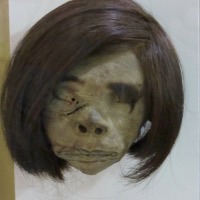
Una Cabeza Reducida

Una Cabeza Reducida

Known by the Shuar as Tsantsa, this “head-shrinking” practice which is agreed upon by many as having ceased, was done to acquire the warrior spirits, Arutam, of the enemy and to prevent these spirits from causing further harm to the Shuar. I believe that there is a good chance that I will return from this trip with my head still attached to the rest of me. The contents of my head however may not be the same as what I started out with.

There are 17 of us plus Paul, the leader. The majority of the group hails from Europe, with the UK, the Netherlands, Belgium, Germany, the Czech Republic, and Poland among those countries represented. We will gather on Saturday the 24th to the south of Loja, the largest city nearby the farm where we will begin. Each of us joined this group to take part in 8 days worth of Natem ceremonies and to attend the workshops necessary to prepare for those ceremonies.

These are Shuar-derived ceremonies, evolved through millennia and developed as an intimate and participatory examination of human placement within, rather than imposed upon, this Amazonian environment. The Shuar are, as are all localized indigenous peoples, masters of the knowledge necessary to be fully integrated into this life. They know the plants, the insects, the animals, the land, the rivers, the skies, and of course the gods who weave each of these parts into the syncretic whole.

By taking part in these ceremonies the group will be exposed to the cosmology of the Shuar and how this unique apprehension of the universe is vitally relevant to the existence of the planet. There is a very real and immediate threat to not only the Shuar and their ancestral lands, but, as the “lungs of the world” this land’s endangered future is a threat to all of us.

The Ecuadorian government has doubled back on its promise to protect indigenous lands, allowing the Chinese, the Canadians, and others access to this vital Amazon watershed for surface mining, with plans to permit the largest surface mines in the world. These mines will destroy hundreds of thousands of hectares of unique drainage basins that feed the headwaters of the Amazon.

These watersheds are among the most bio-diverse ecosystems in the world and once they are removed from the Amazon’s life-cycle the entire planet will be adversely affected. Such an environmental violation will not have simply a small ripple effect, but rather an immediate and enormous negative impact on how the world breathes.

By inviting us to take part in such ceremonies the Shuar hope that the knowledge and experience that we gain will help us to help them tell the world of this most critical series of events. The Shuar, the Achuar, the Siona/Secoya, the Cofán, and others live in an ecologically unique part of our planet.

Just off the Ecuadorian coast, the large El Niño clockwise current from the north collides with the even larger counterclockwise Humboldt current from the south. Coupled with this phenomenon is the equally important and  constant collision of prevailing winds, both easterlies and westerlies.

All this occurs both near and above a small (about the size of Colorado) but topographically varied land that ranges from sea-level to 20,000 feet above the ocean. What results are more species of flora and fauna per square mile than almost anywhere on earth, only rivaled by Colombia just to the north.

The Shuar intermontane lands lie between the snow-covered Andes and the low flood lands of the Amazon itself. This area of hundreds of rivers, waterfalls, and jungle forests is home to an unknown number of species where new discoveries happen virtually year-round. So that they might protect this land, and that they might reverse an impending ecological disaster of immense proportions, the Shuar invite outsiders to their home.

After 8 days of ceremonies and workshops, approximately half of our group will continue on, further into Shuar territory, to live with 2 separate families. While with these families we will observe additional healing ceremonies among the families themselves. And I have been invited to teach English to the children from both of these families and meet with teachers in a high school near Gualaquiza. We will stay directly in the homes of these families, with the first family near the pueblo of Gualaquiza, then with the second family near the city of Macas for another several days, finally heading back to Quito by bus.

With Spanish as their second language, many Shuar believe that their children should pursue English to better position themselves as a voice to the outside world. They are now actively working to create a formal English language program and in the meantime welcome any preliminary help that they can find.

I have been told to expect a lively recruitment response to my visit, and look forward to conversing with them in what is a second language for both of us. What a fantastic chance to waltz through the linguistic minefield of subjunctive verbs!

There is a far better than fifty-fifty chance that I will be offline for the entire 18 days, so this could well be my last post until mid-May. Though unable to post, I will continue to write while traveling in Morona Santiago, capturing some to the wonder of this area, and I hope to convey some of that wonder when I re-connect.

The Subjunctive is Only Subjective When You Don’t Know That It’s Real

After a 24-year hiatus I returned to school in the 80’s, this time to finally earn a degree. A crippling back injury had just ended 20 years of construction, and thus my general contractor’s license, my plumber/gasfitter’s license, my residential electrical certifications; all that was gone thanks to a cast-iron bathtub.

So one day I found myself sitting in a linguistics classroom, having just been introduced to the genius of Benjamin Lee Worf, a pillar of US language and thought. Worf developed what he called “Linguistic Relativity” which argued that one’s perception of the world is entirely mediated by one’s language. A northern European cannot comprehend the realities of an African Bushman anymore than a Tokyo businessman can truly know the ontology of an Anatolian shepherd. Makes sense to me. So much so, that I considered changing my major from psychology to linguistics.

imageI considered the change for about 3 days until the Chair of UNM’s Linguistics Department finally convinced me that Worf’s theories had been roundly dismissed as bunk and his theories were no longer regarded as valid. Well, there was no way that I was going to pursue a career in a field where the leading lights were so misguided. By this time linguists were enamored with the “universalist” theory of Noam Chomsky and others, which argues that regardless of language, all humans are ready and able to understand the world in exactly the same way.

Yet, as Native Americans know, time is circular rather than linear, and Worf is finally returning (though slowly) to a seat of prominence. I’m hoping that the other dim bulbs now holding down the linguistics fort will get out of their laboratories and into the field where they belong. Maybe some of them will head south into Latin America and face off against the world as defined by the subjunctive verb.

I have recently had my own head-on collision with this other world. Yet as fascinating as the difference is, I am too under-qualified to be able to adequately perceive some of the subtler differences, so I’m asking for help.

This posting is really an open letter to my sister-in-law Candice, married to my lovely younger brother. Candice is a true US of A hero: she’s a high school teacher. And for an impressive number of decades she’s led the heathens and the unwashed; your kids, and his kids, and her kids, and those kids over there (but not my kids, I don’t have any, HAH!) out of the darkness of monolingualism and into the amazing world of the Spanish language.

As a teacher of Spanish she spends 9 months in the classroom and the other 3 months shepherding hoards of the little ruffians through Spain and/or a number of Latin American countries. If any of you think that public school teachers have 3 months of vacation every year, call her up and volunteer to help control adolescent hormones in a foreign clime. It ain’t a piece o’ cake.

I’m writing this to Candice, but if anyone else has more than a ¿Donde está la biblioteca? understanding of the 3rd most frequently spoken world language, welcome aboard. Please throw your hat in the ring. Because I believe that, after more than 10 years of reading, writing, listening to, and speaking this language; why, I may have made some progress today. And I’m asking for clarification. Today’s Spanish class was great.

It was an ¡AH, HAH! Moment that I had this afternoon. A Moment that rarely comes in one’s lifetime. And I’m not talking about those LSD-trippy days of the 60’s, when we all went ah hah. Back then we finally understood the universe, except when we came back down from the trip we saw it was just that the red flower was the only one in a bank of yellow ones. Good riddance fringed bell-bottoms. No this Moment today came about from re-acquainting myself with the subjunctive mode in Spanish verbs.

Wikipedia tells us that the Subjunctive is:

adjective
adjective: subjunctive
1 1. 
relating to or denoting a mood of verbs expressing what is imagined or wished or possible.
noun
noun: subjunctive; plural noun: subjunctives
1 1. 
a verb in the subjunctive mood.
the subjunctive mood.noun: the subjunctive

Now that that’s cleared up, we know that subjunctive is an adjective, except when it isn’t. Or maybe it’s a noun, but then, what about verbs? I mean it might be, but then again who knows? Or really, for all us English-speakers: Who Cares? We have painfully few examples of the subjunctive in English. We have little direct knowledge of what is vital to more than half-a-billion Spanish speakers. Let me give you an embarrassing example. Or maybe it’s 2 examples, depending on how you look at it, or them.

One of the fascinating websites that I used to get ready for my trip and still use to learn about culture in South America is Medellin Living. Three hours south of Honolulu I’d have been in the middle of the Pacific. But 3hrs south, non-stop, from Miami, I’d jubilantly deplane in Colombia’s trend-setting world class city of 2 million. A city that astounds new arrivals almost by the hour.

If you still think that you’re being informed, truthfully I mean, by the likes of CNN or Fox “News,” or the other side of the same coin, MSNBC, or some other infotainment channel, then I’ve got a scoop: Pablo Escobar’s been dead for 30 years. Although interestingly enough, his hippopotami aren’t, but I’ll let you Google that one; they’ve become a very serious environmental issue. The point being that Colombia as a whole and Medellin in particular are worth a much closer look; and Colombians love yankees.

I’d be a whole lot safer walking Colombian streets than those of my home town, Detroit. My original plan for this trip, a plan that still carries a modicum of truth, was to refine my language skills in Ecuador, Peru, and perhaps Bolivia, before landing in the north of South America. I may still make it. I’ve been planning to get to Medellin once I can (barely) understand the staccato rhythm of their rapid-fire brand of Spanish. Sooo, where’s the example of a subjunctive world?

Medellin Living is primarily geared for a younger generation of hip and worldly mobile that won’t spurn a good time. Medellin Living, along with many other topics, tells you how to date Colombians. Thus, a frequent topic is that of addressing effective ways to break down cultural and gender non-specific, specific, and pan-specific barriers. In other words: how to party on the weekends and hold down a job, if need be, during the week. Or learn a language, or fly a kite. There are some serious local competitors for this last treat, so be warned, you warriors of the sky.

Often 2 people, say for example: a gringo boy and a Latin American girl, will meet and seemingly hit it off very well, perhaps even seeing each other several times, with maybe (or not) a bit of intimacy involved. Nothing perhaps very exclusive as far as a relationship, but also not simply a casual, “Oh yeah, I remember, you were at the party too” kind of encounter either.

Then the girl will suggest doing something fun together soon, and she will call the boy back to set it up. She will have specifics about where to go, what to wear, which songs to dance to, etc. She’ll have enough detail to let the boy know that this is really something she’s not just simply thought of, but really plans to do. So he waits. And he waits. And he waits for a call that never comes.

This is such a common heartbreak that Medellin Living devoted an entire article to the unwary and vulnerable to serve warning of a pitfall as real as the pickpockets on public transportation. I first read about this some time back and also encountered corroborating accounts as well. Which allows one to suppose that I’d recognize a parallel behavior if it ever came my way. Yet I fell for it too; TWICE!!

My first Spanish teacher and I spent a great deal of time together, 5 days per week for 5 weeks straight. We even met a few times after class when we shared a meal with her delightful husband. So when, during a taxi ride back to the school, she asked if I wanted to accompany the 2 of them to Otavalo in the northern mountains for a weekend of work, I said yes. Her husband, Edison, is a veterinarian who works for the federal government.

Edison travels the whole country administering to wild animals in their natural habitats, even spending weeks at a time in the Galapagos Islands. He gets paid for the privilege of seeing what us gringo clowns pay $500/day to see. (Not this clown; 3 days of that kind of Galapagos luxury and my monthly budget would be shot.) So when his wife said that we’d be helping him tend to “A condor, or an eagle, or some kind of big bird,” I believed her. She said she’d call and she was my teacher, so of course she’d call, right? That call never came and she never mentioned it again.

Fast forward 2 months. Raquell’s gone off to a different school (Spanish teachers here are hired guns. They work as independent contractors and are always hustling for work in a highly competitive field.). I’ve come and gone to Cuenca, fully immersed myself with another teacher and everyone tells me that my Spanish is really accelerating.

imageLast week, walking home in the rain, who do I see but Raquell. She goes all Ecuadorian on me with the kissy-kissy on the right cheek several times. That is the standard greeting here in the middle of the earth, and you better remember that it’s the right cheek or else you’re in for a painful close-encounter.

When she’s finished with the greetings and a soulful thank you for the parting gift I gave to her and her family, she asks what I’m doing in 2 weeks? It’s not like my social calendar is overloaded, so I guessed that I could probably be available, why? Well she and her husband are going to Esmeralda, the home of Afro-Ecuadorian culture on the northwest coast. And she wants me to come with them for the weekend. Edison has to work with yet another ill-defined animal, needs help, and would I join them? Willing to prove that suckers really are born every minute, I naturally said yes. And then went home and got ready to pack. And, yes of course, wait for the call.

The weekend of note has come and gone, and I finally stopped waiting. So while you’re winding up for a culture-wide condemnation of the Spanish-speaking world, let me stop that silliness before it leaves the box. In general, and particularly in the sierra (the mountainous regions of South America) the cultural norms are ones of refinement and respect wrapped heavily in courtesy. Which to our North American eyes seems impossibly contradictory to this other, set-me-up behavior. How could someone who knows that she will probably run into me again before I leave in 6 months, lie to me so boldly?

Unless it’s not a lie? Unless, and this is where I need some context, it would only be a lie if the person posing the invitation didn’t want it to happen in some dreamy far-off world where wishes can come true?

Gabriel García Marquez, the late Colombian author, won his Nobel Prize for Literature by writing “One Hundred Years of Solitude.” The Nobel Committee says that it doesn’t award for a single book but rather for an author’s body of work. They lie. Marquez introduced the world to what has become known as Magical Realism. If you need a visual example of Magical Realism, re-visit “Like Water For Chocolate.”

This truly wondrous book from Marquez follows a family of note through 100 years of its life, running forwards and back in time, playing with linearity like a rubber ball. The common tie across generations is the ghost of the grandfather showing up again and again offering sage advice and codging a drink of booze or 2. And the idea of what is real and what is imagined, what exists and what defines existence, and if the mind wants something to be real, who are we to deny that it isn’t, is central to not only Magical Realism, but I think to the core of Latin American thought.

I do not believe that Raquell set me up any more than the heavy breathers in Medellin were set up by the Colombianas. What I do think is that with 14 verb tenses in the Spanish language, and half of those tenses in the subjunctive mode, Benjamin Worf is still right on the money. We are, as a species, held captive by the words we use and they way we use them.

OK class, the grammar lesson is over for today. Your homework consists of reading a book, watching a movie, or writing in the subjunctive mode about what could just be real. Or not.

image


South American Explorers Club

I’m here in Quito, a short city bus ride from the Equator, El Mitad del Mundo: the Middle of the World. This being the tropics, with visions of steamy heat, jungles, humidity and all that goes with these notions, you’d think that this is what I’m contending with. And except for the humidity, you’d be totally wrong.

I’m here at my desk wearing long-johns, a fleece vest over 2 sweatshirts, fingerless gloves, and a wool watch-cap, struggling to keep warm. Ah, the tropics! Tonight the South American Explorers Club, or SAEX (Quito branch) is hosting an Open House and I’m looking forward to being there. Of course meeting with 4-dozen expats, Ecuadorian nationals wanting to practice their English, German and British students just loving life, and cheap beer are incentives enough. But the clubhouse also has a wood fire burning in the living room fireplace and I really want that heat.

SAEX/Quito Open House, March 2015

SAEX/Quito Open House, March 2015

The Open House is both a monthly fund-raiser for the non-profit Club and a very effective way to break down cultural barriers by providing a low-key venue for an international blend of the curious, the shy, the extroverts, the singles, and those pretending to be single, at least for one night.

It was a pretty broad mix of ages, from 20-somethings to pensioners. There was even an octogenarian newspaper editor from a suburb of Albuquerque who was there visiting his son, married to an Ecuadoriana. I’ve already marked my calendar for next month.

SAEX/Quito, aboard the Chiva

SAEX/Quito, aboard the Chiva

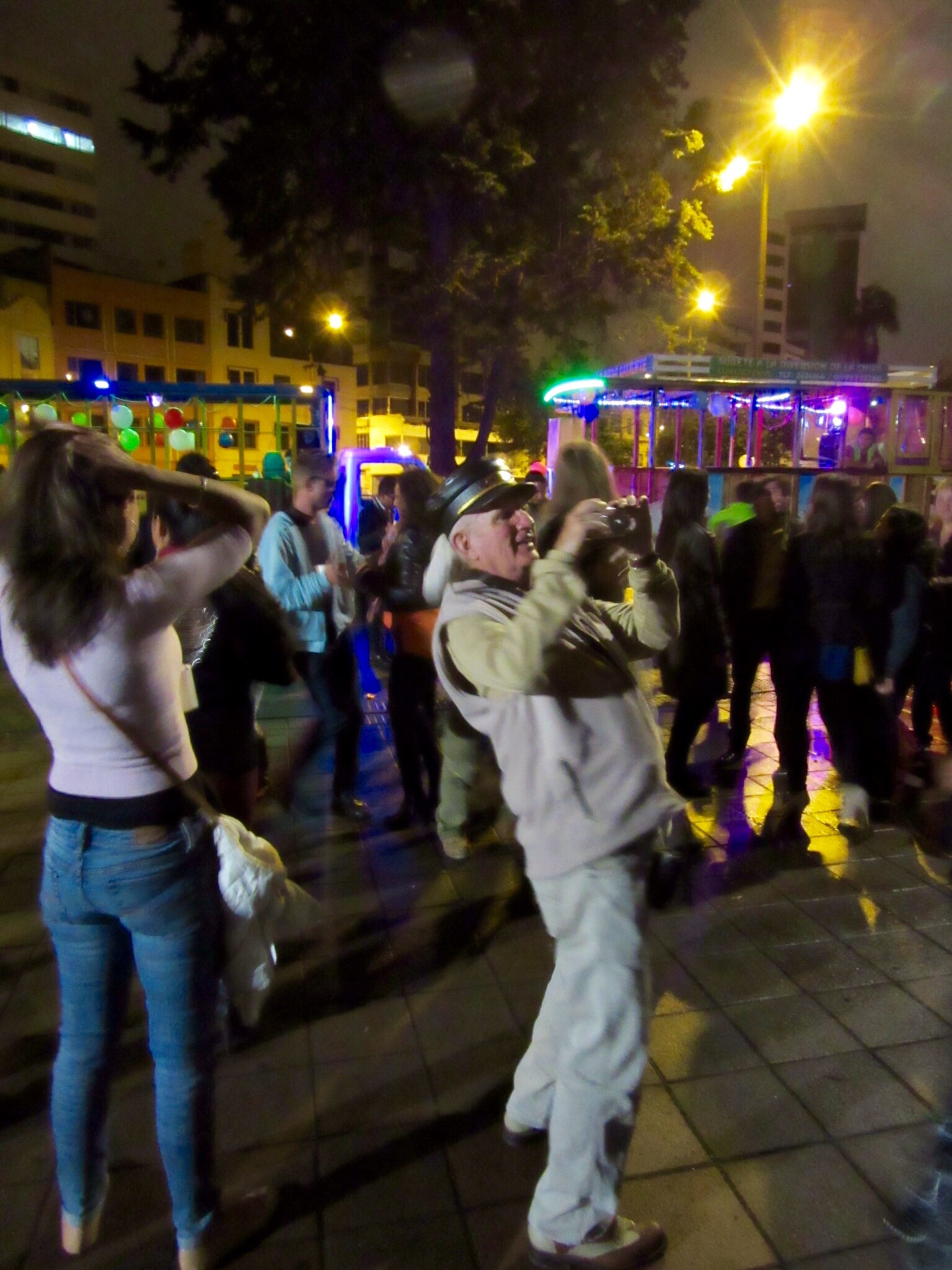
Next week (it’s now several days later) SAEX hired 2 Chiva vans. These are really converted cargo trucks with the beds outfitted to carry several dozen happy, loud, and wild revelers each. We were thankful for the covered tops, since it’s winter here and the night saw an off-and-on drizzling rain. The Chivas are a popular way for folks to enjoy club dancing without the clubs, cover charges, or buying drinks.

Both Chivas parked and ready to rock & roll

Both Chivas parked and ready to rock & roll

Everything is included in the $10 ticket; just hop aboard and cruise the city, and dance!. We eventually did stop at one of the parks, where all hopped off and danced along the sidewalks. Each of the Chivas had its own DJ and each had 4’ tall speakers announcing our musical progress as we snaked through Gringolandia (Mariscal Sucre) and Centro Historico for 2 hours.

Lest you think that SAEX exists for throwing great parties, there really is more, far more. The Quito branch spent several years working with the federal government here to clean up the language school business. There are more than 200 language schools in Quito alone, with new ones coming as quickly as old ones shutter their doors. Many operate out of garages, and virtually all of them host impressive websites, snaring the young and unwary from afar.

SAEX helped design a standardization process and the few schools registered with the national certifying board guarantee students a no-surprises education. When I first arrived, I rented a room here at SAEX and worked my way through their literature before choosing one of the qualified schools. When I leave here to move further north, I’ll use their guidelines to choose another language school in Otavalo.

The club also supplies members with guidebooks, personal recommendations, and one-on-one instructions on how to live and thrive both in Quito particularly, but also in the country as a whole. Membership in the Club provides hundreds of discounted opportunities for restaurants, hotels/hostels, tour guides, travel agencies, theater events, and new offers that are constantly changing.

Should the need arise, SAEX can recommend English-speaking healthcare options. I’m sitting here in the living room waiting to accompany several of the members who regularly see a dentist that they like. I’m ready for a teeth-cleaning visit and will join the other 2 for an unscheduled drop-in.

John Caselli, SAEX/Quito Club Director, taking control

John Caselli, SAEX/Quito Club Director, taking control

More than 35 years ago the first Club opened its doors in Lima, Peru. Now there are 4: another Peruvian clubhouse in Cusco, a brand new one that just opened near Valparaiso, Chile, and this one here in Quito. The local clubhouse is run by John Caselli, a retired US Marine pilot and flight instructor. John provides clear direction both for day-to-day requirements, and also for long-term planning such as the language school standardization.

If anyone has the vaguest notion of visiting South America, or just simply learning about one of the most fascinating areas on this planet, SAEX, with its $60 yearly dues, is a goldmine of information and a great way to meet some fascinating travelers and very curious and enjoyable Ecuadorianos. Next weekend the Club is hosting one of its many hikes that take place several times each month. You should join us.