Monthly Archives: July 2015

Climbing the Steps of the City of Zaruma and Climbing the Ladder of Success in Loja

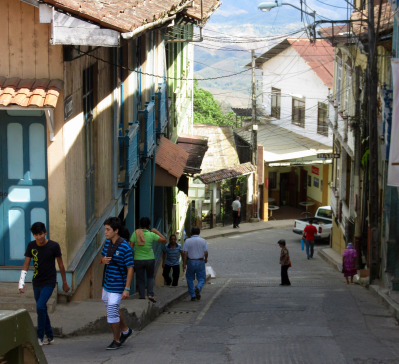
Zaruma, de la Provincia de El Oro, is unquestionably the most vertical city that I have ever visited. Roads, at least those planed for motorized vehicles, are at best an afterthought throughout the entire municipality. In a city, a village really, of barely 20,000 residents there is a developed and inhabited area that marches up and down the mountain for more than 1,000 vertical feet.
Zaruma Steps

Zaruma Steps

This isn’t a place for someone with a fear of heights. Since as you move about in just the commercial area of Zaruma alone, you move along in the street, up steps, down steps, over curbs, up more steps and then repeat. A still active mining town, Zaruma is like no other. And because of this, Ecuador has petitioned the UN to place it on the short list of World Heritage sites. It certainly has my vote.

Though as beautifully unique as it is, a village this size only has so many things one can do, and with wi-fi being something that not all of the residents had heard about, keeping myself plugged-in was it’s own interesting challenge. It’s a nice, no it’s a great place to visit, but you know the rest.

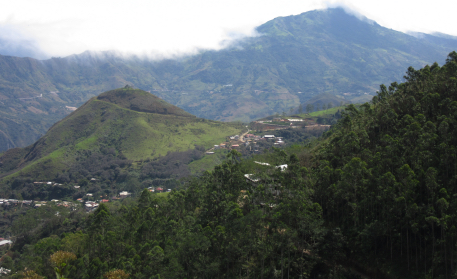
Three days later I hopped on a bus out of town for the most beautiful yet frightening bus ride yet. The first hour was pretty tame: we coasted downhill to the smaller town of Portovelo where I changed buses after a long wait in the town square. Within 3 minutes of leaving Portovelo the pavement ended and we started climbing up into the Andes.
Zaruma to Loja Road

Zaruma to Loja Road

I was thrilled to be on this route because near the end it would meet up with the road I had taken out of Catemayo in April to attend the Natem retreat. That path ended at the door of the finca we stayed at and this ride would complete the rest of the journey coming in from the opposite direction. However these interprovincial buses are very tall affairs with great stretch out seats.

They are far taller than a Greyhound back in the US, so that when we rounded bends on the one-lane gravel road and overtook an overloaded mining truck, or met an oncoming pickup, my heart lumped up in my throat as the cabin swayed along the hardpack. We weren’t making much speed, since the gravel and washouts prevented over-jouncing along the way. But we were moving about, perched 8 or more feet above the road surface.

We did of course survive the trip. The drivers of these buses do this every day and know the twists and turns of their routes intimately. So at the times when I knew we were going over the edge, the driver carefully and methodically maneuvered this beast easily along to our destination. The days in Zaruma were a true march back in time and this bus ride punctuated the divide.

But now that I’m in Loja, life is different. Somewhere in the vicinity of 200,000 people call Loja home (accurate population figures and, for that matter, municipal boundaries are more of a concept than a reality in much of South America). Considered by the rest of Ecuador as the jewel of the south, this city holds a long memory of mining and agricultural wealth. But it’s the 21st century. The old days were nice and there will always be respect for history (Loja is one of the oldest cities in Ecuador), though I get a clear message here that folks want nothing more than a comfortable middle-class life.

And who can blame them? With the wonders of cable/satellite TV, dubbed Hollywood movies, and the Internet, all the excitement of the outside world beckons, and many here have answered. They have seen much that favors the attraction of a comfortable life and have decided to follow this dream. It’s the American dream, but it’s not exclusive to the US. This is also America, America of the South, and let no one forget it.

With a city of this size, geographically isolated though Loja may be, one can find most anything imaginable for leading the comfortable life. These days that also means that Loja has caught the eye(s) of travel and retirement media as the “new” Cotacatchi, which everyone who’s anyone knows is the “new” Cuenca. And for those who have followed these types of publications, we cannot forget that Cuenca of course was at one time the “new” Ajijic/San Miguel de Allende, and they of course were the “new” on and on and on…

So there is a small and slowly growing expat population here, and these retirement publications are all singing praises for Loja. Of course the result of this favorable press is that expats are moving here. But they are in no way as visible in Loja as the expats are in Cuenca, where they have seemingly taken over the Centro Historico, or are they as visible through sheer numbers, as they are in tiny Cotacachi. But expats are here and they do blog and the blogs make for some interesting reading.
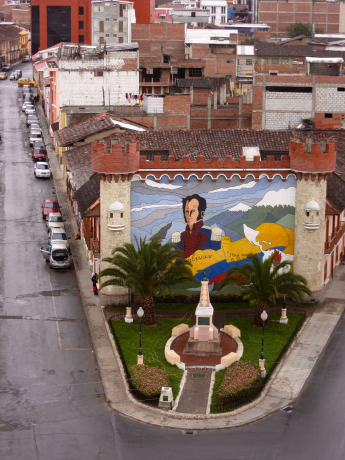
Bolívar Enters Loja

Bolívar Enters Loja

As regards expat life, Loja is still in the first stages of “colonization” and this means that the transplants here are a hardy bunch, by necessity speaking Spanish, and who are quite content flying under the radar and not flocking or swarming as in the other locales. These new Lojanos are happily leading the middle-class life too and fitting in quite well with families tracing Lojano roots back in some cases to the founding of the city in 1546. Ah, but nice though it may be, that same middle-class longing is where problems arise.

Rafael Correa has changed the face of Ecuador like no other president before him. Regardless of how one applauds or rejects his views, his redistribution of wealth essentially made a new country. In multiple comparisons to other South American nations, Ecuador has lifted itself from an also-ran to a contender in virtually all aspects of social metrics. Correa’s administration has lifted more people from poverty than all of his predecessors combined and the country is now in the top tier of wealth, prosperity, and individual contentment across all factors of life in Latin America. Crime is down and happiness is up.

Because of the wealth re-distribution there is now in Ecuador a large sector of the population that not only can simply dream about material gain, but actually achieve it through individual effort. This has never happened before and the people who this message was intended for have embraced it whole cloth and gladly worked hard to move up the ladder; out with the old ways and all aboard for the new ones. Yet differences exist here in the beautiful and rugged south.

Unlike Cuenca, the cultural capital of Ecuador, or Cotacachi, near to the world market of Otavalo, or the main cities of Quito and Guayaquil, Loja is off the (international) tourist trail. It is at the bottom of an isolated valley, nearly 7,000 ft above sea-level, and surrounded by rough and mountainous mining country. Loja therefore is at the mercy of its geography, and as a result of these defining landforms the city, like any city anywhere in similar circumstances, has an insular outlook on life and the values that define it as a community.

Seeing the world of the outside and how the Loja of old compared to that world, and seeing progress as good thing, it was only natural that Loja too would be moving forward. If hard work and a clear vision were the antidotes to stagnation, then Lojanos were ready for their share of the rewards. It would be worth it for now and for the future. But at what cost?

When I arrived here last Thursday I had several immediate tasks before me. In order to stay on the road I have certain regular chores and the occasional “one-off” task that come up. This last week I needed to have some laundry done, a haircut, and some forms filled and mailed back to a US bank. I also wanted to purchase some palo santo.

This sweetly aromatic wood is burned in curandismo ceremonies and next week I begin a 12-day retreat hosted by 4 curanderos. The plan was to purchase quantities of palo santo for each of the shamans as symbolic offerings. Once I leave Loja I will be again in isolated country south of Cuenca and unable to locate such things. So Loja is where I had to find my palo santo.

Booking a room in a centrally located hotel in colonial cities has many benefits, not the least of which is convenience. There is a reassuring sameness to the layout of old Latin American cities. Each has a parque central: a green-space (sometimes more green in concept than in currency) which will have fronting it the city cathedral, the local governmental offices, and provincial and/or federal agencies as well.

Radiating outward from the park will be the supplementary and complementary businesses, shops, and other modes of commerce that keep the community operating. The tailors, the hardware stores, the cyber cafés, and pharmacies, restaurants, and more. Big cities and small pueblos; this layout is both regular and reassuring.

Loja Mercado Centro

Loja Mercado Centro

Among these surrounding stores will also be the mercado central. This will be the grand market selling everything from local produce (which in Ecuador is astounding in variety, beauty, taste, and incredibly low prices), meats: both the butchered and often the live still clothed in feathers or fur, toys for the tots, sweets for both the tooth and the heart, umbrellas, shoes and boots, basketware, items for the kitchen and home, and many, many other items in a large warehouse or series of warehouses with running kids, pleading mothers, hawkers for both licit and illicit goods; a fascinating place to watch one’s belongings while weaving through the always crowded aisles.

Loja’s grand market is barely 2 blocks from my digs, the Hotel Podocarpus, and after scouting it out on Thursday just before the 6pm closing, I knew that checking off my tasks would be a snap; there was even an internet café, so I could print out the forms for the bank. The central post office was 2 blocks in the other direction from my hotel. Perfect! At least mostly so.

After finishing up most of my tasks at the mercado with a $2 haircut (and it looks like a $2 haircut too!) on the top floor amidst the row of barbers, I set out to find the palo santo. In Quito, Cuenca, and many other communities along the major transportation routes, tiendas de remedios (shops selling folk remedies) seem to be on almost every street corner. Yet I couldn’t see any, either in the mercado or along the side streets lined with shops selling everything but remedios.
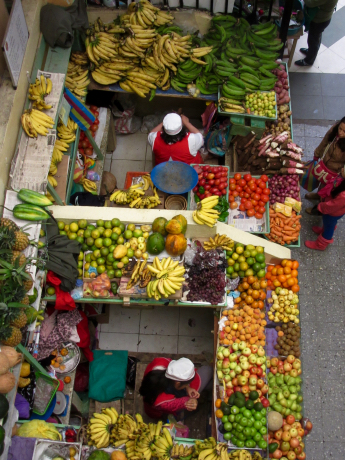
Mercado Produce

Mercado Produce

So I asked one of the vendors in the mercado who gave me a puzzled look and then pointed me off in some vague direction elsewhere, a common gesture when someone doesn’t know something but can’t bring ones’ self to admit it. So off I went to another sector, got the same treatment, and repeated this a number of times until the husband of one of the earlier vendors found me several aisles over and pointed out a tiny closet of a shop one more aisle down.

Finally! Success with what turned out to be the last remedio shop in Loja. It was getting late with rain threatening, so I was thankful that I did find my palo santo, and that the old man selling the flower-waters (floristas), trinkets, salves and such had 4 bundles left. He was both quite pleased and puzzled to find a gringo as a customer, and after our transaction admitted that not only was he the last, but that his supply of palo santo had dried up from over-developing the forests for farmland. He also told me that for 10 years or so, fewer and fewer people are following the old ways and that he was going to close down this last of the remedios in Loja.

In their climb up the material ladder, Lojanos have willingly forsaken indigenous ways and plowed up the once plentiful palo santo forests. For progress. Other communities here in Ecuador, ones located on busy and regular transportation routes still accept the old ways and have comfortably integrated them into newer ways of living. There is no real conflict in those cities and both beliefs of health and healing exist symbiotically. However, these folks here in Loja, walled in by the beautiful but culturally stifling mountains, concluded some time back that it was an either/or choice and made their move forward by saying goodbye to traditions that had been in place for millennia. Something was lost here in Loja.

Out of Guayaquil and On to Zaruma And Back in the Mountains

The Howler monkeys were a bust. We could hear them grunting high up in the Royal Palms, and we smelled their excreta (similar to the “apples” a horse will leave as it makes its way down the street in a parade), but except for some moving fronds, no sightings. It wasn’t a complete surprise since a group of school kids, 20 or so, set out less than a 1/2hr before us. What with their screams, shouts, and other teenage vocal discharge, this pretty much sewed up any chance for a primate encounter on this day’s outing.

So, as the family from Wisconsin, our guide Eduardo Meneses, and I made our way back to our driver Freddie and the van, I figured it would be a good time (I had dropped back to last in line) to relieve myself of the morning’s coffee. We had been walking for an hour and previously riding a 40′ motorized canoe for 2hrs before that, so now was as good a time as I was going to have. But the Chonta snake, Chironius carinatus, stretched out in the understory felt differently.

In Parque Central, Zaruma

In Parque Central, Zaruma

Bashful Bladder is a not uncommon urological condition that many males confront during our lifetimes. Often it can be outgrown as a man matures. Yet in an instant, I reverted to childhood as that snake and mine stared each other down. At the time, I didn’t even know that it was a Chonta, and though it didn’t look particularly venomous, it also didn’t look particulary pleased either.

And it wasn’t about to give ground at that point, based on its rearing its head along with about a foot of its 5ft long body. While I learned later that not only is it non-poisonous, and full-grown can become twice that length, at this point in my life herpitological taxonomy was not high on my list of must-do’s. Ever so slowly backing away I watched its 2 bright yellow longitudinal stripes slide into the brush in the opposite direction. Walt Disney was never like this!

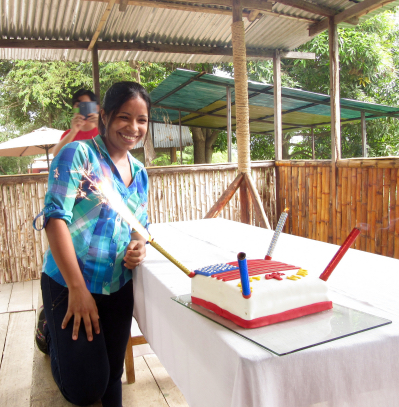
Fortunately, our next stage, lunch and then a tour of a cacao farm, was far more lighthearted. Ninfa, the daughter of the farm’s owner, and a high-energy recent college grad, was our hostess and guide. After our main course of Pollo Seco, a regional chicken dish, she brought out a Stars-n-Stipes cake in our honor to celebrate the 4th of July.

Ninfa and Our 4th of July Cake

Ninfa and Our 4th of July Cake

Later she walked us through the land her great-grandfather had cleared 100 years before. By most chocolate experts, Ecuador is recognized as producing much of the world’s best bean, and the “Champaign” region of Ecuador’s best was only a short distance down the highway from where we were sampling this fruit. Ninfa took us from germination to seedling to grafting to the eventual harvest of the 1/2 dozen varieties her family grows.

She then demonstrated the advantage of 4 days of sun drying the seeds over oven-baking (less chance of mold and a better, richer flavor), and finally the roasting which transforms a fruity tasting pulp into what we  know as nibs. These are ground into a cocoa butter which she mixed with her family’s crop of dragon fruit, and mango juice, and produced an amazing drink that became even more so with a bit of aged rum.

The whole day spent with Eddie, the owner of Guayaquil, A Guided Visit Tour Guides, was a wonderful exposure to the Guayas Peninsula. Eddie is a native of Guayaquil and his love of place is ever-present in his interactions with the network of farmers, fishermen, street shills, museum staff, and others he works with to show us the life here beyond the popular tourist guidebooks.

Earlier that day, while we glided through the mangroves very similar, and yet also very different, from the Florida biomes I’ve visited previously, we saw how the province and the central Ecuadorian government are working to halt further wetland destruction. The country’s 4th largest source of income is the harvests from shrimp farming and this industry has been the biggest threat to mangrove stands along the coast.

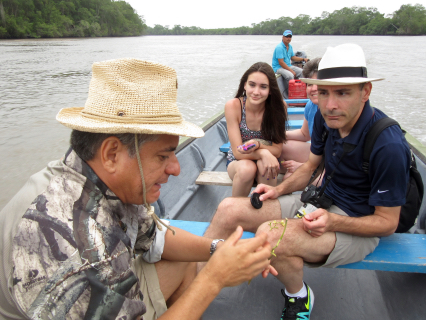
Eduardo Meneses in Manglares Churute Reserve with the Wisconsonites

Eduardo Meneses in Manglares Churute Reserve with the Wisconsinites

Many areas in the Guayas Peninsula have been reclaimed from those same shrimp farms and now the trees, crabs, and other elements of the original habitat are returning. But it’s still an uphill fight. It takes time, and curious tourists, to help more Ecuadorians see that saving and revitalizing the natural habitat can be as profitable, or in many instances more profitable than monoculture crop production. Next time you head to the Galapagos, stay awhile in the Guayas Peninsula and it will benefit us all.

But enough of this heat and humidity, an hour ago I plunked down the princely sum of $4.40 and bought a bus ticket to Zaruma, the original capital of El Oro Province. El Oro was originally named for the pre-Inca, then Inca, and finally the Spanish Colonial gold mines in the hills and mountains that spill into the sea, at the Peruvian border. Now the gold comes from bananas, and Ecuador leads the world in banana export. With a lock on the European Common Market, and a major share in the US and elsewhere, Ecuador means bananas and bananas mean Machala, the current provincial capital.

When I started my tour of the country after leaving Quito, Machala was high on the list. But with the chance to visit the Amazon Basin having become a reality, Machala lost my custom. I’ve been told not to regret this since the city has no tourist facilities, but I was essentially told the same about Guayaquil and found quite the opposite. Perhaps getting to or from the Galapagos I can make amends and find the time to visit the “ugly” port of Machala.

Seeing the port of Machala, which transits so much of Ecuador’s wealth, really is of high interest to me. And when people tell me that there’s really nothing of interest, nothing to see, I simply cannot accept their notion of what matters. Immersive diversion (hanging out in tourist bars, standing in lines for tourist attractions, etc.) is not what I consider touring. I want to know what/where/how a country works. Machala is a place where that happens.

And so is Chimbote, Perú. When I was in Lima I learned that Chimbote is the country’s largest fishing port, which like Ecuador’s bananas at Machala, makes Perú tick. So in a few months, after I’ve been run out of Ecuador, I’ll start to plan for the smelly fish-capital of Perú, and visit another town “of no interest.” But next is the mountain-sided mining town of Zaruma.

Well it’s now 8hrs later and I’m ensconced at the Hotel Zaruma Colonial and sitting out on a restaurant balcony enjoying both the end of daylight and my first meal since breakfast at 7am; I’m famished. I’ve only seen a small bit of this small town, but it looks like fairyland: most of the houses are wood, a rarity in Ecuador. This is the direct result of a disastrous earthquake nearly 200 years ago that totally destroyed the town. In rebuilding, the town leaders decided to abandon the plentiful stones nearby and harvest trees from the surrounding forests.

So. I’ve had 8hrs of sleep, saw the town square after sunset (top photo, really!), and now I’m off to the mines. But after breakfast, please…

Can You Like a City And Not Like Its People?

Perhaps Term-Limits Do Have a Place in Modern Politics

Guayaquil is a gritty, sticky, smelly and crowded place with more homeless than I’ve seen elsewhere since I’ve been in South America. The weather is dismal: hot, humid, with mostly still, dank air and a breeze only rarely. When you think of the tropics and your thoughts are not kind, Guayaquil (“Gwhy-a-Kill”) could at least be a placeholder for your archetype.

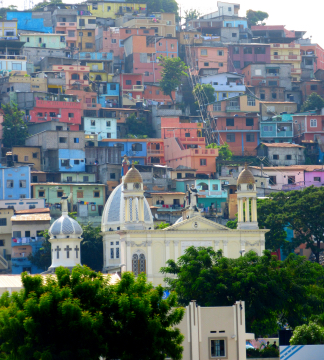
But I really like this city. In the city center, where my seedy hostel is located, there are buildings more than one hundred years old (and occasionally double that age) and beautifully preserved, sprinkled liberally throughout the barrios. One revitalized barrio, Las Peñas, is a multi-colored maze of old houses, tiendas, boutiques, and restaurants seductively climbing up a hill overlooking the Guayas River.

Barrio Las Peñas

Barrio Las Peñas

The showpiece of Guayaquil, the Malecon was a rundown and crime-ridden slum along the waterfront less than 2 dozen years ago. Now, after millions of dollars of makeover, it is a 2.5km long, pleasant and picturesque place to stroll. These most recent days it is even more active, for along with the rest of the city center, the workers along the Malecon are preparing for Pope Francis, who will visit Guayaquil in less than one week’s time.

There are banners and bunting all over this part of the city, with multi-storey’s tall pictures of the Pope and his quotes adorning many of the big buildings near and even on the grand cathedral. Of course even though he is not expected to generate the excitement here that will come when he chews coca leaves with Bolivia’s President Morales later this month, nevertheless one can feel the emotion and pride brewing locally. And with the power-washing machines blasting away mold and mildew from many of the larger buildings, this part of the city is looking pretty fine, thank you very much.

The sad part is that the day after the Pope has come and gone, Guayaquil will revert back to being an also-ran in the Pantheon of must-see South American destinations. But why? Each year the Galapagos Islands compete with Machu Picchu as the most visited place in all of South America. And each year tourists drop half a billion dollars on the islands. And no matter what people think or how they book their cruises, you only get to the islands via Guayaquil, period. You may think that you’re going to visit the islands via the capital, Quito, but you will fly here nevertheless.

Half a billion dollars to a developing country is some serious cash. Yet this, the largest of Ecuadorian cities has effectively no tourism infrastructure. I just came from 2 weeks in Otavalo, an indigenous city of about 90,000 people, roughly 1/30 of the size of Guayaquil, and yet every restaurant that I visited, and that was about a dozen in the time that I was there, had wireless internet. But here in the city center? Nothing! I can get an advertised 1/2hr free along the Malecon (though they cut you off after barely 20 minutes!), and I can get it at the Ecuadorian version of Starbonks, called “Sweet & Coffee” but that’s it. What’s up with that, City?

Perhaps it was a cost-cutting measure, but the city now only has a single tourist information office. After visiting 3 times, I believe that I’ve had more than enough. The only person I get to talk to may as well be a robot; in fact, I wish that she was fully automated so I wouldn’t have to fake being courteous. She’s only capable (or perhaps only willing) to talk about the Malecon, the high-end hotels, or the shopping malls. When I asked her, during my final time about a good restaurant with comida tipica, or regional food, she could only talk about fast-food places. I repeated several times that I wanted neither fast food nor fried or greasy food. But she only could talk about the same thing, over and over an over. When I asked about a restaurant that had wi-fi, she just looked and said nothing. When I repeated my questions, she took out a phone book, turned to the restaurant pages and showed me the listings. I again repeated my questions and she had no idea what to say, she could only point. This is not what a tourist office is, I’ve been to ones in cities that care. I’ve been to ones in cities that realize the value to city coffers that tourists bring. Guayaquil is not that city.

And that’s the problem: this city doesn’t care. They have an alcalde, a mayor, who’s been in office more than 15 years and he needs to go. His name is plastered over every surface imaginable, and yet he has no clue about how badly he is harming this city. The central government of Ecuador is spending great sums of money promoting the country world-wide as a tourist destination, but the guy running the country’s largest city is clueless. He really, really needs to go.

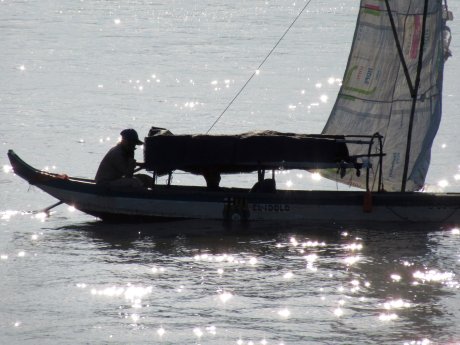
Fisherman, River Guayas

Fisherman, River Guayas

When you read online travel forums you see that the main message about Guayaquil is to spend as little time as possible on the way to the Galapagos; get in, get out, and get going. This is an outrage and it is a message that should have been countered years ago. It is a message that is thoughtlessly hurting the city when instead this could be a place where people actually look forward to spending some extra days. Virtually every other part of this fascinating country has a great tourism infrastructure, but not here. What a sad state of affairs for a situation that doesn’t need to exist. Who is running this place anyway?

But as I say, I do like the city. Today I took a double-decker bus tour (there are 2 different tour companies, but the first one I went to, 4 separate times (and right there on the Malecon), never seems to actually have a bus that operates. Yet I had a great time with the company that actually does have a working bus, even when the driver backed into a tree heading out from the ticket office and smashed the glass window inches from my head. Well, I quickly changed seats and spent the rest of the trip cautiously ducking as he passed a bit too close to many power lines, light posts and other tree branches. In spite of his driving though, the bus ride was very interesting.

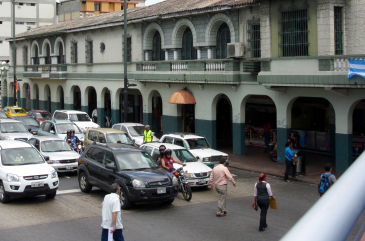
Build-Out, Old Style

Build-Out, Old Style

Build-Out, New Style

Build-Out, New Style

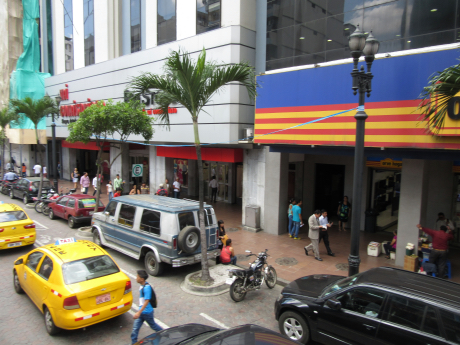
Because of the heat and the equatorial sun, the architecture in Guayaquil has retained an interesting element of sameness. The old buildings still standing are of an identical nature that builds the second and successive storeys above it out over the ground floors; every building has this feature. It’s more than a portico, since the actual floor space above the ground floor extends outward rather than just providing a roofed overhang. And it’s not cantilevered, since there are columns to support those higher floors. This design helps pedestrians escape the direct sun and the plan works so well that the newer buildings have adapted accordingly and integrate the same design. These newer structures aren’t nearly as attractive as the old ones, but they do provide us walkers with  an escape route from the killer sun. My sincere thanks to the architects who refuse to fix what ain’t broke.

I really do like this place, just not the way that it’s run. Or the people that run it.