Monthly Archives: May 2016

On Seeing “Eiffel’s Bridge” in Arequipa


In my next life (unless I come back as a toad!) I will be an engineer: either structural or mechanical, I’m not sure which. This I believe because I am drawn to making things, to fixing things, to replacing things that lack with things that provide. I like to do this and I appreciate and seek out what others have done with similar intent.

Here in South America I am often awash in both architectural and folk history. Walking through colonial neighborhoods or even whole, preserved villages is a thrill that never grows old. And while wandering in el campo (the countryside) I often see machinery or tools that are job specific.

Many of these devices are both ancient in use and yet still current in function. Whether in farmer’s field, miner’s shaft, or mother’s kitchen, these devices, implements, tools have beauty in their utility. Even if silently, I always thank their makers.

So when the guidebooks and the Peruvian Tourist Office and people on the street told me that Arequipa has a bridge designed by Eiffel, well, you can guess my mission. I had to see this creation. More importantly, I had to touch it.

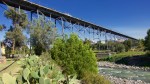
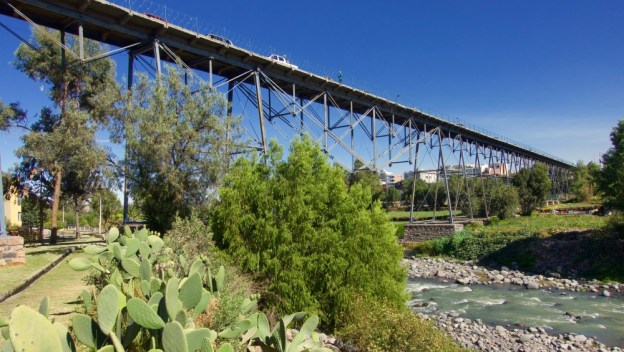
The bridge spans the Rio Chili just south of Arequipa Cercado, the central and historic district of the city. Built around 1870, known locally as El Puente Bolívar, the bridge was designed to carry twin tracks of trains.

It was completed barely a year before the first trains arrived from the coast. Arequipa would now be linked to the outside world. For most of its 3 centuries this Second City of Perú had existed as a separate oasis. Isolated and fertile, boasting a sunny and dry climate.  Arequipa nevertheless was not a perfect paradise.

Two years before the completion of the bridge the city was totally destroyed by the earthquake of 1868. Through the centuries since its founding in 1540, the city suffered horrendous damage from nearly a dozen major tremblors. Yet they were, none of them, as fully disastrous as the 1868 quake.
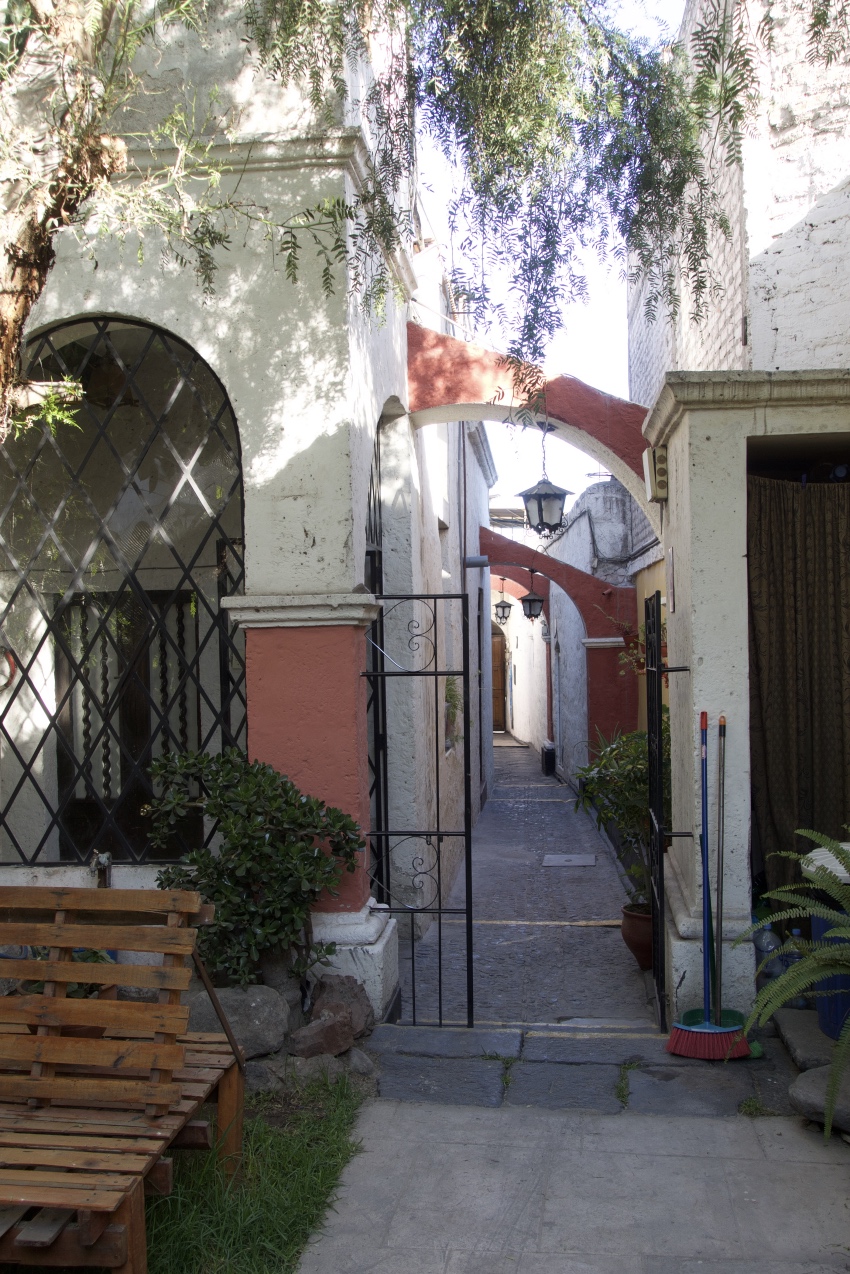
La Casa de Sillar, my home for the month of May

La Casa de Sillar, my home for the month of May

But a new city arose from the rubble and this bridge symbolized that rebirth. I was looking forward to my visit. My route from my hostal, La Casa de Sillar, took me through the main plaza. From there the path led me through a beautiful neighborhood of century-old homes.

These homes are all constructed from volcanic tuff, known locally as sillar. Sillar is a hard, white stone and it gives the city its nickname: The White City. It was a pleasant 1/2 hour walk to the base of the bridge and past these well-preserved beauties.

I started my excursion surrounded by single storey colonial and post-colonial buildings. The stroll ended in an upscale neighborhood of townhouses and condominiums with neat green spaces here and there. Eventually I met the bridge, suspended a full 5 storeys above me, along the left bank of the Rio Chili.

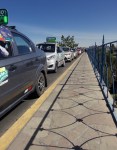
It’s a far more delicate and less imposing structure than, say the Brooklyn Bridge. And it lacks the drama of the Mackinac Bridge of my youth. But even so, it is living and working history and I wasn’t disappointed. Arriving near the end of morning rush, I saw above me that the bridge had filled with stalled traffic. It is a single, one-way artery connecting the 2 sides of the river.
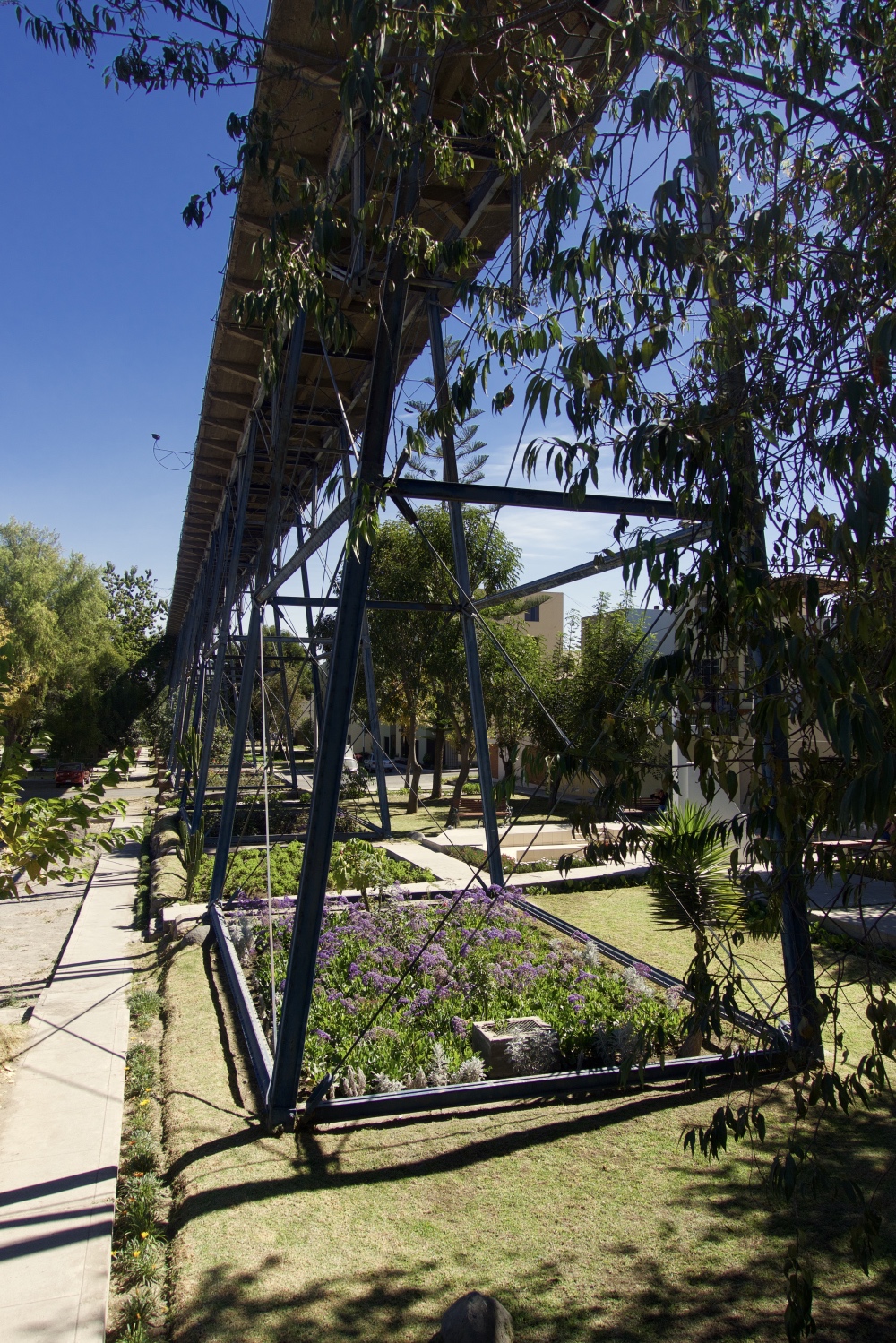
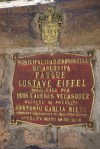
Gustave Eiffel Park

Gustave Eiffel Park

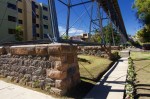
From where I stood, at the river-side end of a small park, the city’s one million residents seemed far away. This park was dedicated in 1988 and named after Gustave Eiffel. It is a peaceful and quiet place: not quite public yet not completely private. Placed in a gated community, but the gate was open for foot traffic. So I went in. I was surrounded by manicured greenery. There were flowers blooming everywhere with grounds tended to by municipal workers.

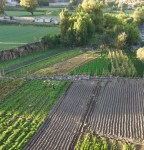
Arequipa is in the desert. The ambient humidity hovers below 20% and the climate is strongly reminiscent of New Mexico. Like New Mexico, the city draws off water from the river. The water is diverted into a system of canals or acequias. This park, watered by one of these acequias, flourishes. And so too, do the farmlands of the floodplain on the opposite bank. They are likewise acequia fed. I had the park to myself and wandered freely.

Acequia, Gustave Eiffel Park

Acequia, Gustave Eiffel Park

I eventually met a man who lived nearby and I asked him about the water. He explained that, again like in New Mexico, these waters are controlled by a mayordomo. This water-boss decides when and how much water is diverted to individual plots. The man I met was friendly enough and surprised to learn of the similarities our countries share for irrigation. But he had work to do so we said our goodbyes and I turned my attention back to the bridge.

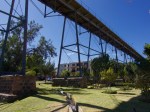
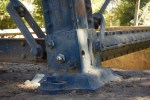
Thanks to Google, the University of Iowa’s School of Engineering website and Wikipedia I learned something of the bridge’s construction. It uses a Fink Truss design to hold itself up. This system was popular with early B&O railroad bridges in the US.

El Puente Bolivar in Arequipa, Perú

El Puente Bolivar in Arequipa, Perú

The Fink Truss employs a series of interleaved triangles. Inherently strong, these triangles support the load of the roadway from underneath. The result is a lacework of steel which, though attractive, has few remaining examples still in service. There are only 2 Fink Truss bridges left standing in the US.
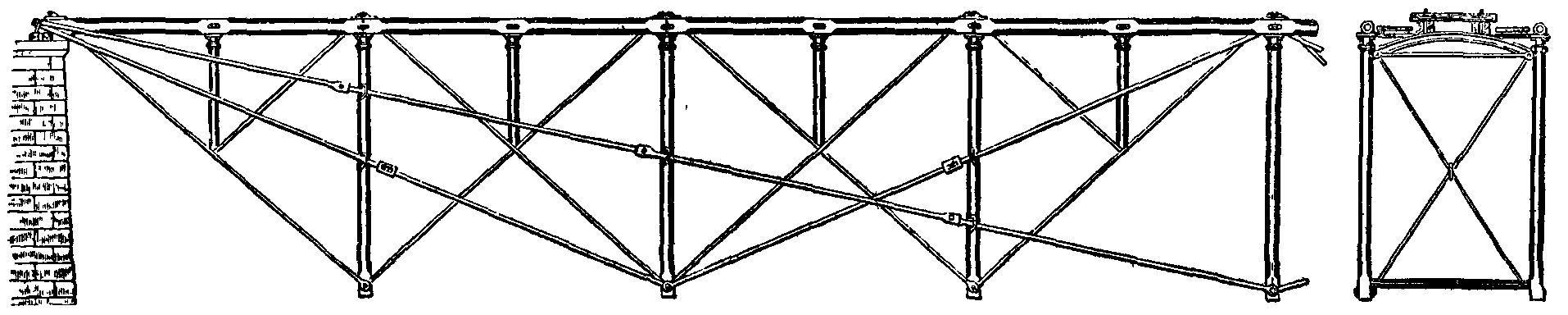
Fink Truss from 19th Century Patent

In the middle of the 19th Century steel was a new building material. The engineers back then were learning as they were building. The Fink Truss is an early example of such inventive construction. However this truss design was quickly superseded by above-grade supports.

Now it was time for another discovery: Eiffel did not build this bridge. He did not design it. He had nothing to do with Arequipa, nor with “Case de Fierro” in Iquitos. Nor, as I learned, did he have much to do with anything in South America.

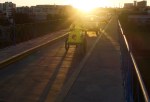
Yet none of this matters, really. The bridge stands, people use it daily, and I was happy to find it. I left the park and climbed the neighborhood stairs up to the roadway. Two pedestrian walkways share the surface with the single lane for vehicles.

I crossed the bridge to the other side where the cars gain access. As I neared the far side I could see many of the cars pause, often for more than a minute before continuing on. This seemed strange until I got to the entrance.
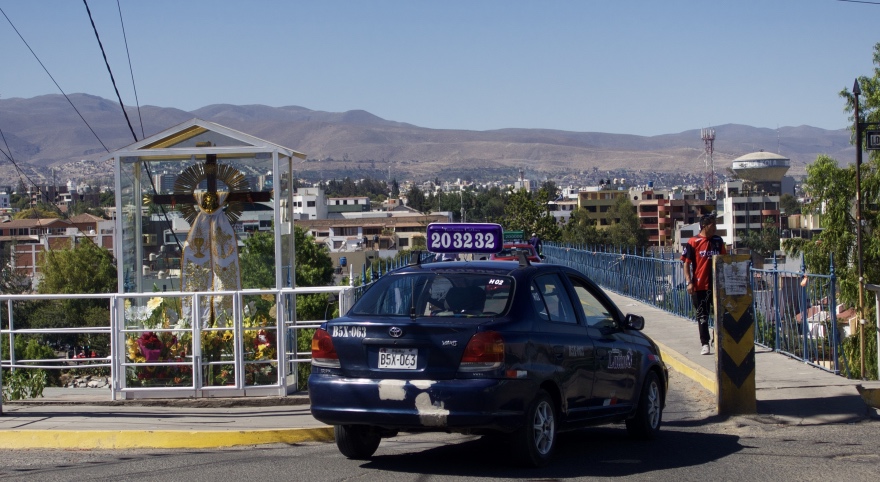
Shrine at Bridge Entrance

Shrine at Bridge Entrance

There I found a glass-encased shrine with a richly clothed Jesus and Cross. Many of the drivers in this deeply religious country would stop, cross themselves and then cross the bridge. As they asked for blessings for a safe journey I too gave thanks: for the chance to witness this bridge.

In 3 days I leave Arequipa. A week after that I leave the country. But if I ever return to Perú this city is tops on my list of places to revisit. The people are welcoming, the climate is wonderful, and Puente Bolívar will still be there.

Finding Shoes, Big Shoes, in South America

When I herniated 2 discs in my lower spine I immediately lost an inch of height. This was back in 1986 and it came right after losing a vicious fight with a cast iron bathtub. Minutes earlier it was just the 2 of us on a staircase when the body said “No more.” And so did my doctor.

He said that if I continued this insanity then more discs would rupture. I was a licensed plumber at the time. Lifting heavy appliances and bath fixtures was the norm. He predicted that after a while I’d be tightening my belt up around my armpits. Literally, not just figuratively, I’d become a knuckle-dragger.

Maybe not in so many words, but that was his warning. It was time for a change. Thus, along with the bathtub, my 20-year construction career truly came crashing down around me. And it left me even more disproportionate than the way I was born. These days though my bigger inequity is my feet.

At the base of a shrinking body I float on size 13 shoes; kind of a circus clown effect. Or maybe an overgrown Hobbit. Canal boats. Land skis. Anyway, as a result I have lived through any number of embarrassing moments over the years: tripping on some things, kicking (not purposely) other things. In the past 18 months I’ve been getting my feet stuck under the front seats of mini taxis while trying to unfold out of the back seats.

All this podiatric warfare has taken a toll on my shoes. My shoes are the only barrier between my twinkling toes and the foreign elements of travel. For as much as 12 hours a day, virtually every day, I am on my feet. I am wandering and yes, even wondering on city streets, mountain paths, jungle trails, in airport terminals, at ferry landings and within hotel lobbies. I’m in restaurant dining rooms, local markets, museum halls and theater aisles. In the same pair of shoes.

My shoes are a mess. Their terminal fatigue has surpassed permissibility in polite company. I need a new pair, badly. Ah, but not so fast. Size thirteens (or 47’s down here)? Good luck, Gringo.

The majority of people living south of the Equator are not tall. Take last night, at the restaurant. My waitress barely came up to eye level as I was seated. While she, standing there wondering what this foreigner might say, was poised with order pad in hand. And that is generally the case. If you expect a face-off, take a seat.

Certainly there are tall Peruvians, and I saw more than one in Lima. However the majority of them were getting out of their Mercedes’ and sprinting to the air-conditioned tennis club; the upper-class whites. When they go shopping, they hop on a flight to Miami. The folks on the street and out of the capital are built like the waitress and dozens of waitresses like her. It’s no surprise that my needs are not their needs.

If you are shopping for clothes and you’re visiting from up north you can try a tourist-focused mall in one of the major cities. With patience you can paw through the racks and occasionally find something larger than a medium in shirts or slacks. Maybe the color’s not right, and not all styles are represented, nevertheless large and extra-large do exist. But shoes? Get ready for a special treat there, Pluto.

When the time came to replace my shoes it was also for me the beginning of a new career. I had no idea that I was to become the frontman for dozens of aspiring comedians. That was revealed when I entered my first South American shoe store. This was in Ecuador. The owner, who happened to be holding a pair of pliers, offered to cut off my toes. In between fits of doubled-over laughter he swore that he could make me cram into a pair of size 9’s. Ah, Ha ha ha.

The thing is, Ecuadorians are giants compared to the many four-foot-aughts I meet on the streets here in Perú. These folks are tiny! Have I said that before? And they sell shoes to match. Trudging through upscale malls in Lima, in Cusco, and finally here in Arequipa I meet with an equal mix of mirth and chagrin at each shop. But we all have a great time and I’m happy to say that I have made the day for many a bored shoe vendor. Shock and awe, but in a novel way.

Because you see in South America it’s not like with Donald Trump. He and Marco Rubio went at it over hand-size, somehow equating such with masculine development. Here, guess what? They whole-heartedly equate the same (and truly believe it) with shoe-size!

My Spanish is getting pretty good, though when spoken rapid-fire I still miss a lot. What I don’t miss though, are the wide-eyes and red faces of the women clerks at shoe stores. Ah, the traveling life.

I was recounting my most recent shopping disappointment to the owner of my hostal, Juan Carlos. He stopped me right then and there. “Kaaal,” he said. (German names are not easy for Spanish speakers) “It’s time to rejoice!”

He knew the solution to my shame. It was found just a half-dozen blocks from La Casa de Sillar where I am staying. His single mother has a torrid yet chaste affair (South America is conservative you know) going on with José and Juan Carlos explained that I had to go see him. José would save me.

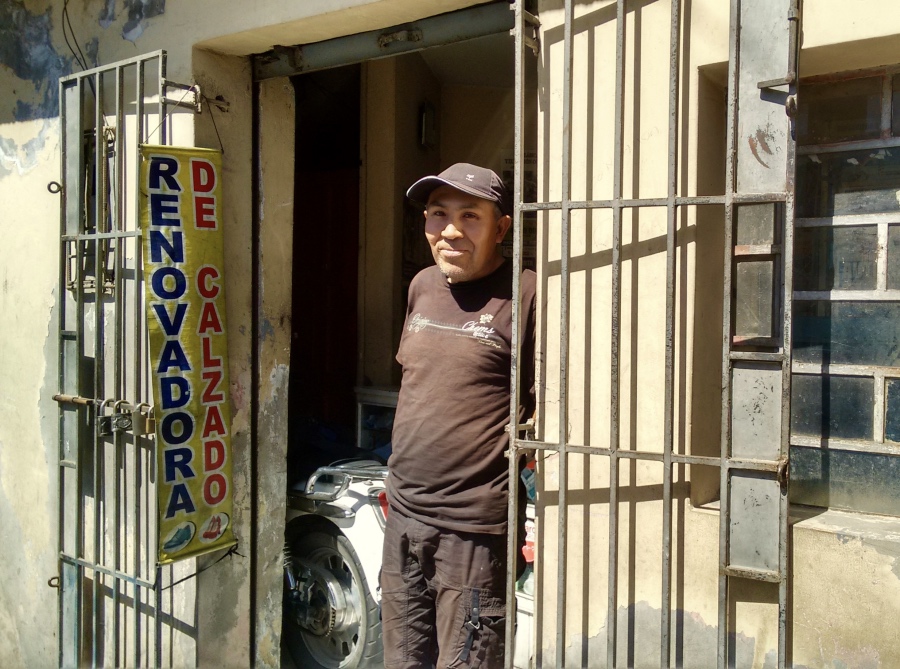
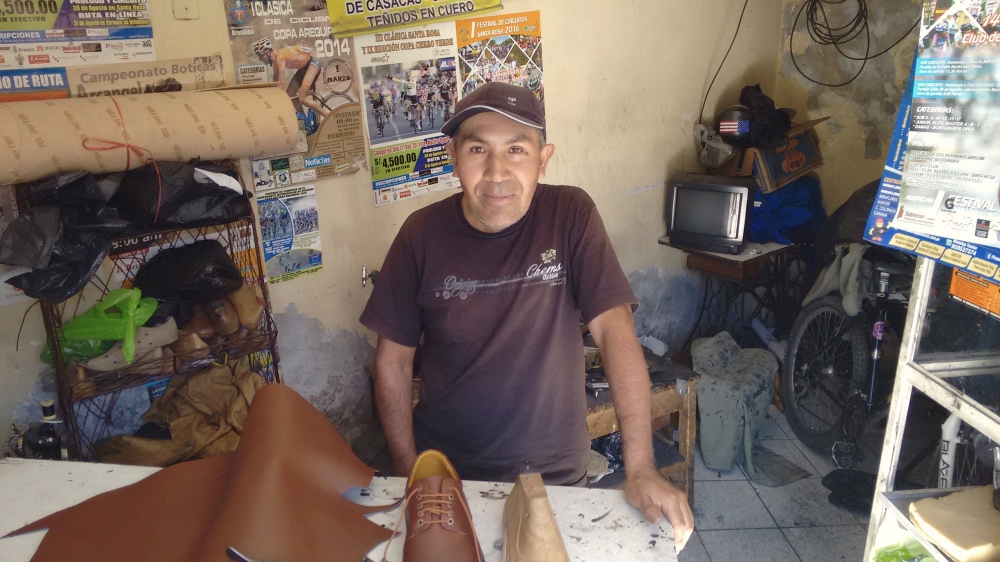
Don José is a zapatero, an old-school shoemaker. I found his workshop just before sunset and at the same time I also met the master himself. He had just pedaled up to the curb on a well-maintained Trek mountain bike. Returning from a 3 hour siesta, he was energized and ready for business. Doña Gloria, Juan Carlos’s mother, had warned him to be on the lookout for the gringo, so he wasn’t surprised to see me. We hit it off immediately.

Don José, with his motocicleta in the background.

Don José, with his motocicleta in the background.

I had complemented him on the bicycle racing posters plastered on his walls. I also mentioned that after retiring from the university I became a bicycle mechanic. That did it. Our friendship was cemented for good.

José competes in his age group (he’s 47) in both road races and on mountain trails. He also rides motorcycles. He had both a road machine and an enduro along with his Trek crammed into the 4’ x 12’ workspace. The shop was lit by a single dangling lightbulb. This place was more than packed: it was floor-to-ceiling jammed.

One of my battleships is on the counter.

One of my battleships is on the counter.

But he found me a foot-high stool and had me hunker down for measurements. As we sat, soon joined by his friend Charles, we spent the next 2-1/2 hours reviewing each other’s lives and dreams. The time flew by. Part way through our talks, José showed me some of his current projects.

He was re-soling a pair of trainers for Doña Gloria, a labor of love to be sure. Plus, he was putting finishing touches on a largish pair of what seemed to be dancing slippers. This elegant footwear in black leather, covered with decorative metal studs, was a custom pair he was crafting for the neighborhood transvestite. I know that this person will like them because they also have shiny metal inserts that wrap around the heels. The inserts match the studs. Fancy is as fancy does.

These shoes of hers say a lot about life in South America. Yes, the countries are conservative. Yes, both the Catholic Church and the political systems condemn the life we generally take for granted in the US. Though back home it’s not that extreme opposites in lifestyles often associate with each other. Nonetheless, our legal system does protect our differences. Except for North Carolina, but that story’s for someone else’s telling.

In contrast, life on the street in Latin America is a working model for “Don’t Ask, Don’t Tell.” As long as you’re not harming anyone, as long as you’re not pestering others with your personal dramas, people here know how to get along. Even when lifestyles and needs are not openly admitted to. I knew that these studded beauties were sure to please.

Of course there are the anal types (Freudian, I mean) who are uptight about pretty much everything. But they are a small part of the Latin population and simply tolerated, but only just. Life here is far more inclusionary than the polarized, exclusionary life most common up north. Liberals with liberals, conservatives with conservatives; don’t cross the street.

“We don’t have much, but we’ve got each other,” are the words to live by in these parts. I’m very comfortable with this. And I know that Andelina (her working-gurl name) will be comfortable with her shoes as well.

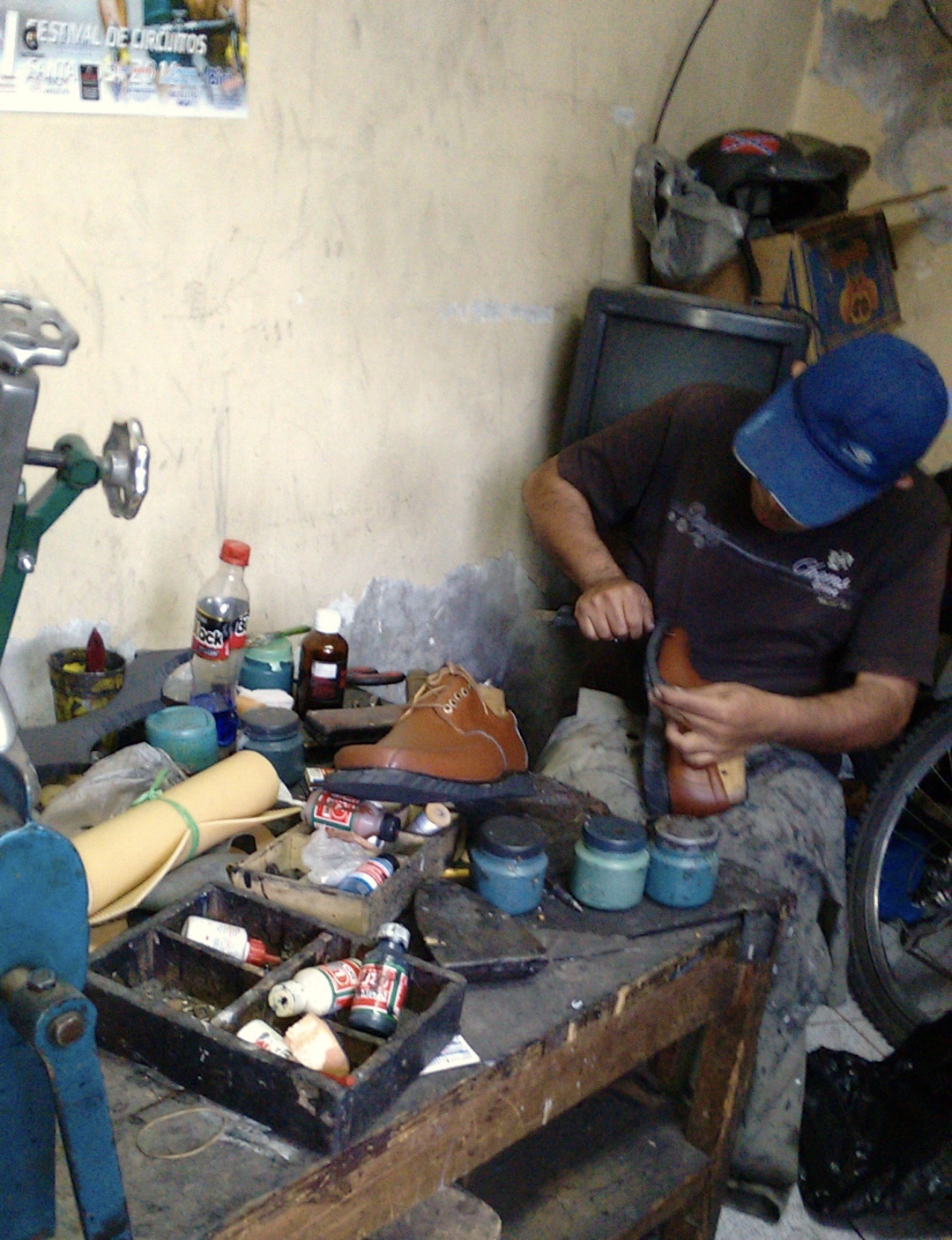
José attending to my Sole

José attending to my Sole

OK, My feet are measured: lengthwise, widthwise, outlined, multiple circumferences noted. I’ve picked out the color: a medium brown; the style: a sober, semi-dress walking shoe. In one week I will have my first hand made pair of zapatos (shoes). They should go well with the new pair of navy wool trousers and gray sports coat I picked out earlier this week.

I’m getting ready for Chile. The people there are living with the most vigorous economic climate in South America. They dress accordingly. I’m tired of looking like a tourist. Or, as another waitress opined to me, a mendigo, a beggar. But she exaggerates: the poor people here dress better than the rich gringos from up north.

For the curious, these shoes have set me back a full forty-five dollars. Sure, that’s a lot of money for custom-made full leather shoes, but this is Perú. That’s how things are done here.

Postscript: It’s a week later, I’m a couple of twenties thinner, and I’m sitting in a restaurant wearing my new kicks. They’re a few hours old but already they feel like old friends. José built in some amazing cushioning (both in the soles and the interiors) and I’m ready for some long days walking south in a skinny country. Prepare yourself, Chile: I’m on my way.

Gracias, Maestro!

Gracias, Maestro!

Mil Gracias, Maestro Zapatero!