Monthly Archives: October 2015

Isla Isabela, an Island With an Attitude; Galapagos Pt. III

I enjoyed my stay on Santa Cruz, but as Janina predicted, it was more for the people than the animals. Certainly the animals were fun and fantastic. Yet having worked in an oceanarium at Makapu’u back in the 70’s, I had been surrounded by and somewhat inoculated to the sight of whales and dolphins, sea lions and seals, penguins and boobies, though not inoculated from the tourists and the schlock.

Puerto Ayora had its quota of schlock with more in reserve should anything be found lacking. As for tourists, even though I was visiting during the off-season there were enough of them out and about that I could only imagine, horridly, what it must be like in the high-season. It’s a question that I hope to never have answered.

So consider this: Way-back-when, after standing eyeball to eyeball with a dolphin (OK, our eyes were probably at least 3″ apart); and with my hand and arm up to my armpit stuck down his throat, pulling out the plastic flowers he had swallowed, I’m no longer filled with visions of unicorns and elves and angels and our noble brothers from the sea. Although, come to think of it: I don’t think that I ever was.

This 1,000lb. beast with a mouth full of needle-point teeth was even less happier than I was by being there, as we were, together. It was not the kind of scene one might have watched during “Flipper” re-runs. And it left me with a working knowledge that while these are impressive beasts, the intersection between humans and animals is usually no fairytale and often not very pretty either.

My point here is that yes, the animals of the Galapagos are an amazing sight to witness, a sight and experience found nowhere else. But I don’t see these animals with the same wonder that others do. I’m glad that I went snorkeling and walked amongst the nesting seabirds, but I gained far more insights walking amongst the nesting humans.

Back in Hawai’i and 40 years ago I’d had a Humboldt penguin nail my foot through a brand-new pair of RedWings. Those work boots had just cost the greater part of my weekly salary! I’ve had my calf sliced open by the razor-sharp trailing edge of a sea turtle’s flipper while transferring it to a holding tank. I’ve disposed of buckets offal and vats of blubber from a beached pygmy Sperm whale after its necropsy on the beach near Kahuku. Though, on the good side, I’ve also built a circus cart for a sea lion to pull through the crowd and made a pair of Elton John-like sunglasses for a dolphin to wear during a fashion show.

Are my views jaundiced towards these creatures? I don’t think so. But neither do I have stars in my eyes when staring down a sea lion in the surf; enjoyable certainly, but transcendent? Hardly. So when it was time to leave Puerto Ayora, I was happy to go. After the high-season, now that at least 1/3 of the shops and restaurants were shuttered, it can be a bit gloomy and careworn.

Puerto Ayora still functions year-round, but it ain’t Disneyland. Instead of Mickey Mouse this and Donald Duck that, the town serves up Darwin on the half-shell. As named on all the islands, I walked down the main drag: Avenida Charles Darwin. One could buy Darwin bar-drinks and Darwin t-shirts and mugs and placemats. And as on 2 other islands, there is the Darwin Research Center and several Darwin statues. Even the chief factotum at my hostal (a friendly and industrious young Ecuadorian) was named Darwin. It was time to visit Isla Isabela, or at least time to leave Santa Cruz.

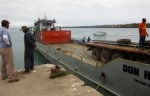
So I took a 6am speedboat (40′ sportfisher really) on a 2hr, $30 rollercoaster ride to the largest island in the chain, Isabela. Janina had arranged my stay, but in the confusion of a dawn sailing I misplaced her notes and never did meet the person who was supposed to greet me at the dock holding my name on a sign. There were a number of people there each holding various signs, but none with my name. So I flagged a taxi and rode the 2km into the island’s only town (pop., about 3000), Puerto Villamil. My plan was no plan really, but to stay for perhaps 3 days, depending on my mood.

Except that while Puerto Ayora is dismal, Puerto Villamil is bleak. With streets of hard-packed sand and garbage strewn along the lava fields, this village is beaten down, knows that it’s down and isn’t putting up a fight. The food is nothing but destitute collections of bits and pieces of something scooped onto a plate while the person dishing it out stands over me and demands an exorbitant price. The bars are tattered and grimy, the hostals are closed. No tropical paradise here.

The place was weird; both in the words of the guide I met the next day and also in my immediate feelings after getting off the speedboat from Isla Santa Cruz. In the ride from the dock to the center of town, with a taxi driver willing and wanting to sell me almost anything, I saw old mattresses and junked TV’s, trashed clothing and broken furniture strewn far across the lava fields and the houses (shacks, really) far more rundown than in Puerto Ayora.

What you find in Puerto Villamil is a sluttish attitude and everyone seems to expect my money, and a lot of it to boot. The people know they have something unique and they milk it for what they can but they aren’t particularly “green” by any means. I found on several occasions that a tension openly exists between a large segment of the Galapageños and transient scientists regarding the environment and it is very apparent here on Isabela.

At Puerto Villamil fishing is a major source of income for my erstwhile and reluctant hosts. And legal fishing, observing and adhering to quotas and obeying off-limit species harvesting is not a major source of joy. The Chinese pay enormous prices for illegal shark-fins and the scarce and protected sea cucumbers, and money talks. Being told that these animals can generate more money alive than dead is a concept as foreign and as ridiculous to the fishermen as is the idea of sustainable tourism.

It’s a true shithole, Isabela is, and I was so very happy to hop on a small plane and leave. I decided to fly to the far eastern side of the archipelago. By flying I would be taking less than an hour’s time instead of spending an entire day shuttling from Isabela to Santa Cruz and finally to San Cristóbal in fishing boats. It was time to visit Puerto Baquerizo Moreno, the provincial capital of the Galapagos. There on Isla San Cristóbal I ended up having the best of times.


Dramamine Monologues: Galapagos, Pt. II

After the first week spent exploring the most populous island of Santa Cruz I was ready for a change. Knowing, though not focused on the warning to beware of what one wishes for, I was in store for a very big change on a much deeper and purely personal level.

So I hopped on a 6am speedboat headed to the largest of the islands, Isabela. By now it was mid September and the calm, tranquil waters offshore were gone. By far the best times for diving were over. With rough seas came silt and sediment, so underwater visibility is greatly diminished.

sea_sick_railing_cartoon

Those of you who SCUBA dive would be best served by fighting the hoards of the July-August high season, when the water’s warmer, calmer, and clearer. It’s also rumored that those times don’t demand a wetsuit either. But 2 weeks after US-Labor Day the lazy days of summer are gone. And so was breakfast for at least 1/3 of the 15 or so passengers on board for the commute. Oddly enough though, not for me.

Some of my earliest childhood memories, predating Kindergarten no less, were of the times spent puking on Sunday drives with the family. Joining my dad, smoking one cigarette after the other motoring down the highway, my mom riding shotgun and passing around sandwiches and kool-aide, was my older brother pasted against the left side of the back seat, hoping to avoid any backsplash. He was mostly lucky in this regard.

670px-Treat-Motion-Sickness-Step-4

Motion-sickness has whipped me about the head, shoulders and stomach my entire life. I’d get sick in wide-screen movie theaters, riding the ferris wheel, often even a teeter-totter, anything that moved in more than one direction at a time; for-my-entire-life. Often my motion-sickness has been the deciding factor, the weakest link, in determining directions, adventures, roads not taken for more than 65 years. What was going on now, here in the Galapagos?

The chop was breaking over the bow from about 10 o’clock, and we were headed due west with a strong wind from the south. This 40’ sport fisher, with twin 300hp Yamaha outboard engines (and a monster 500hp spare) was battering through, under, and occasionally over waves while fish-tailing and slipping sideways with constant irregular lurches. And I wore the biggest ear-to-ear grin the entire time enjoying the bouncing and pitching and rolling the sea was throwing our way.

So here’s a disclaimer: an hour before launch I had downed a Dramamine. Having grown up using the drug I also knew that it rarely if ever had a damping effect on my upchucks. But I had received what may turn out to be a lifetime supply of the stuff earlier in the year from my support staff back in Hawai’i, specifically delivered to me for my Galapagos trip. I really wanted to visit these islands and overcome my dread of the sea with handsfull of the pills.

But not only didn’t I have the least bit of queasy feelings, I pushed my luck and started reading my Kindle part way through the ride. The chop was so intense though, that I had to stop for fear of cracking the tablet lens on my forehead. Nevertheless, this was a major event; I couldn’t bring on even a hint of discomfort. Another test was in order.

Six days later I boarded another boat, this time from San Cristóbal back to Puerto Ayora on Santa Cruz. Believing that I am my own best Guinea Pig, I chose to wait until the boat was underway before downing a pill; normally Dramamine takes 1/2hr to an hour to kick in. 

This trip, if anything, was even more violent than the first and I was sitting amid-ship, inside and away from any views of the horizon or anything else but fellow passengers. This location was where the pitching was far more noticeable. It’s hard to imagine, but my grin was even bigger than during the first trip. What was going on here? An older gentleman taking the commute in the stern of the boat and confined to a wheelchair was thrown to the deck 4 times from the strength of the battering waves (he was grinning though the whole time though, a great sport). I badly needed a reality check.
Back in Puerto Ayora I met with Janina for a deep debriefing. The week before she told me that when she was younger her father had insisted that she have an ayahuasca ceremony. She had been experiencing some very serious health issues that were just not responding to “conventional” medicine and he believed that it was time for a more traditional indigenous approach. So, knowing that this woman is wise beyond her years, I sat down and talked this nausea thing out with her. We both agreed that something deep was going on here.

During my April-May ayahuasca intensive I received 2 separate messages from la medicina. The 2nd message dealt with my immediate future in Ecuador and revealed that it was time to quit Quito, which I subsequently did. But it was the first message that had a connecting link to this motion-sickness issue.

At the time I arrived in Ecuador, and for nearly 5 years previously, I had been plagued with what my primary care physician diagnosed as “intractable nausea.” He was of the notion that a chronic liver condition that I have was the root cause of the nausea, but being cautious he wanted additional opinions. So I spent several years and multiple thousands of (health insurance) dollars with medical specialists trying to pinpoint the origins of this nausea. All of these examinations failed to discover anything definitive, though I did receive several scares of more serious conditions. It was fortunate that those frights were all false alarms, and yet the nausea remained.

So when I received the first message from the ayahuasca ceremony, clearly explaining what the cause was and how to cure it, I was very happy to be lying down at the time. I was rocked to my core. And now, talking to Janina I realized that I was experiencing continued healing from that ceremony from nearly 6 months earlier.

Clinical research, both here in Perú and elsewhere in South America, has frequently shown that ayahuasca can and does have delayed healing effects. While it could be argued that my experiences are purely anecdotal, I’m getting ready for another experiment.

successs-sounds-a-lot-like-motion-sickness_Fotor

A few hours south of Lima are the Ballestas Islands, billed as Perú’s answer to Ecuador’s Galapagos. It is my intent to go there without any Dramamine at all. This Guinea Pig’s ready for some real action. As the year winds down we’re now heading into a showdown with El Niño and the seas are not smooth and they are becoming less so with the passing weeks and months. If I’m truly over my life long motion-sickness I’ll know it pretty clearly. If not, keep your boots on.

But enough about me, what about you? We were talking about Isla Isabela, the largest of the Galapagos Islands, so let’s get back to business.
The Galapagos is More Than Just Animals

A lesson that I am constantly relearning is one of patience. It’s a lesson of immediate importance as I try to explain my time in the Galapagos. In just over 2 weeks that I spent there I was assaulted; in a friendly way to be sure, but assaulted nonetheless. From the minute I left the hostal and walked down Charles Darwin Avenue, new experiences, new sights, new everything piled up in front of me, on top of me (pelican shit on my hand and my camera: wear a hat, please!), all around me.

For several weeks I’ve struggled to find a way to begin this story of what happened during my time in that very special place. I’ve begun nearly a dozen attempts and each one felt hollow and stilted and in no way a true explanation of how deeply I was affected. Thankfully, and out of the blue I believe that I can now solve this problem. It started with a song.

Paul Simon’s “Boy in a Bubble” was the catalyst I needed, and the line where he sings that we have — no, that we demand: “Staccato signals of constant information” nailed it for me. So here goes. I’m going to present you with facts and factoids. You’re welcome to piece together what you will.

We hear of (and insist upon) Take-Away Points and 6 Reasons to Do This and 5 Foods to Eat or to Never Eat for That and 50 Ways to Leave Your Lover. So I’m going to start with the Power-Point of the trip. I’m dividing up my story into several separate posts that ebb and flow with what I did, where I went, what I saw.

Off the top of my head, this is what I saw:

  • Fish
  • pipefish
  • 15” clown fish
  • parrot fish
  • tangs
  • sharks — 3 kinds
  • Birds
  • vermillion flycatcher
  • yellow warblers
  • Galapagos doves
  • owl
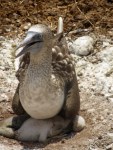
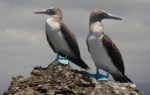
  • blue-footed boobies
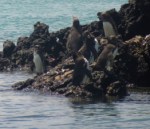
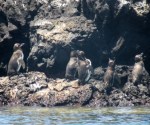
  • penguins
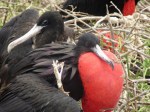
  • scissor-tail frigates
  • pelicans
  • ani
  • plovers
  • rakes
  • rails
  • Darwin’s finches
  • cattle egrets
  • great blue herons
  • yellow-crested night herons
  • flamingos
  • mockingbirds  — several kinds
  • seagulls
  • coots
  • Galapagos ducks
  • White-cheeked Pintail ducks
  • Gallinules
  • Sea Creatures
  • sea turtles
  • star fishes
  • sea urchins — 4 kinds
  • sea cucumbers  — 2 kinds
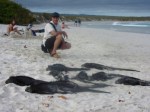
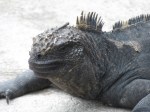
  • marine iguanas
  • sea lions
  • stingrays
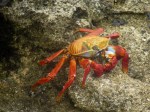
  • crabs — 3 kinds
  • unknown fish by the oodles
  • Land Creatures
  • Galapagos tortoise — 2 kinds
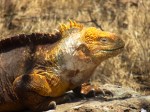
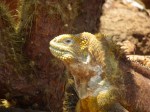
  • land iguanas
  • striped racer snake
  • rat (squashed and desiccated)
  • indeterminate lizards large and small
  • people big and little and each with an interesting story

I know that there was more, that there had to have been more, but for now: that’s what I saw of the fauna. The flora ranged from giant opuntia cactus forests in the desert areas, to highland cloud forest plants duplicating in look and in feel the tree-fern forests of Hawai’i, plus vast tracts of palo santo trees with their stark white trunks and branches. I saw bugs up the yin-yang, scientifically speaking, and so very much more that I will still be processing the information overload for some time to come.

I spent approximately $132/day for the 15 days I was there. That’s an all-inclusive rate of expenditure which includes a round-trip flight starting and ending in Quito, a twin-engine hop between 2 of the islands and 2, 2hr $30 speedboat trips between 2 other islands. This also included all meals (breakfast was included in 1/2 of my hostal nightly room-rates), lodging, 1/2-day and full-day tours, plus obligatory tips to the guides (you cannot go anywhere without one).

The trip could have been cheaper had I wanted to purchase groceries (even cheaper still if I had brought them packaged from the mainland) and cooked at any one of the hostals I stayed at. But I didn’t. It could have been vastly more expensive had I booked one of the many 5-day, 8-day, 2-week cruises on one of rusting hulks or gleaming yachts available, especially had I booked during the high-seasons of July-August or the Christmas-time holidays. But I didn’t.

So there you have it, the quick-and-dirty. No need to read any further, just pack and go. And you’d better hurry since these days those academics in the know claim that within a (human) generation the islands will have become so genetically polluted from tens of thousands of visitors (carrying seeds on their shoes, insect eggs in their clothes, and smuggled produce with their luggage) that the magic of the Galapagos will be gone forever. So go, now! You will never forget the experience.

And if you stop reading now you won’t be disturbed by my conclusion that all of this was almost a distraction to the real Galapagos. You’ve been warned. Here be dragons.

In 1818 the Nantucket whaling ship Globe, under Captain George Washington Gardner, discovered a “mother lode” of sperm whales some thousand miles west of the South American coast approximately at the equator. He returned to Nantucket in 1820 with more than 2000 barrels of sperm whale oil and the news of his discovery. This led to an influx of whaling ships to exploit the new whaling ground and the Galapagos Islands became a frequent stop for the whalers both before and after visiting what came to be known as the Offshore Grounds. This led to the establishment in the Galapagos Islands of a kind of unofficial “post office” where whaling ships stopped to pick up and drop off letters as well as for purposes of provisioning and repairs.

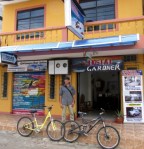
Or, at least so sayeth the Wikipedia. These days in the Galapagos one can find Gardner Islote (islet), Gardner Shoals, Gardner Bay, and even a place to stay during a visit, Hostal Gardner in Puerto Ayora, the main city in the islands.

TripAdvisor (copyright somewhere, no doubt) told me that this very same hostal was a great backpacker place to stay, so I did, and remained there for more than half of my time in the Galapagos. By the time I landed on Baltra Island I had traded several e-mails with the manager, Janina Chong Murillo. She seemed friendly enough.

Baltra Island has the main airport in the Galapagos, the other being on San Cristóbal, the Provincial capital. Once you land on Baltra, nothing but the remnant of a shield volcano and no more than 50’ above the sea at its highest point, you immediately board a bus for a 10-minute ride to the ferry landing. From there it’s another 20 minutes across a few hundred yards of water to Santa Cruz Island and the home of Puerto Ayora, the main city (12,000 pop.). But that city is a 45-minute ride from the dock, across the island (north to south) that climbs to the high-point (3000’) and then back down to sea-level. Waiting for me at the dock was Marlon Arias, Janina’s boyfriend.

Marlon works part-time at Hostal Gardner. He’s like many island residents, not just in the Galapagos, but Hawai’i for one is the same as are other island cultures. Full-time jobs are the rarity on rocks in the middle of the ocean and people survive by stringing together threads of employment, often unrelated to each other. Take Marlon, for example.

Often I’d find him on the computer at the main desk of the hostal, working the books and balancing the accounts. But find a phone booth and like as not you’d see him changing into a uniform of El Parque Nacional Galapagos Ranger (ed. note: for you younger folk, this last sentence refers to a quaint artifice of the antiquities whereby people would actually step into one for strange and occult reasons, or occasionally make a phone call!).

When not at the hostal Marlon flew a single-engine plane to the far and uninhabited reaches of the island chain, patrolling the waters for illegal fishing, instances of which there are far too many. He learned his craft and earned his license at a flight school near Orlando, Florida where he became hopelessly addicted to bacon-double cheeseburgers, the poor soul. We seemed to hit it off and had a pleasant talk of life and love as we made our way to the hostal, a block inland from the waterfront in downtown Puerto Ayora. It was then, when we off-loaded my bag and I checked in that all my plans changed.

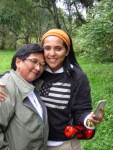
Janina, a beautiful young woman of 34 was there at the desk to welcome me to the Hostal, to the city and to the Galapagos. There are those times when you meet a stranger and immediately know that all bets are off. You can tell that your preconceptions are headed out the window. Once the formalities and innocuous pleasantries were over Janina let me know that this was to be one of those times.

In a seemingly innocent manner she explained that while people from all over the world come to the Galapagos to see the animals, the local people are really what was most interesting. This was something that I was totally unprepared to hear and it stopped me stock still. It was such an outrageous statement that somewhere deep in my visceral core I knew that somehow, some way she was right. With her offer to help I decided that I would test this hypothesis.

But come on! These are the Galapagos Islands, famous the world over. Everyone knows of their most unique and untroubled animal populations that set Charles Darwin on an intellectual journey which put science and religions upside down and still generate deep controversies. People sacrifice, often deeply, for the one chance in their lives to be here among the furry and the feathered and the scaled creatures found nowhere else on this planet. Yet here is this hostal manager telling me that something else, not in any guidebook in any language, is just as interesting; and maybe more. What??!!!

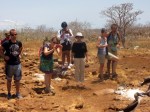
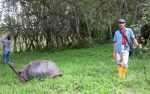
Janina knew that it would take some time to digest this lump of information, so she gave me the rest of the day off. However she let me know that not only would she plan and arrange all my tours and visits for the 15 days I would be there, but that the next day I was invited to go with her and some of her family on an excursion. We would be headed up to the highlands in search of wild Galapagos tortoises, free-ranging on an organic coffee plantation. Who am I to blow against the wind? (thanks again, Graceland) Of course I said yes.

Let me make this clear: before I got there Janina and I were total unknowns to each other. She also never heard of the South American Explorers Club and I knew nothing of her but her name and her occupation. That was it. But not for long.

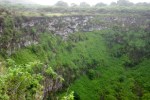
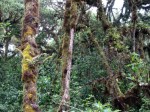
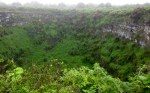
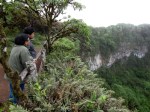
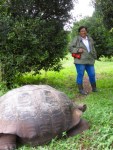
Then the next day after lunch we drove up there to the misty forests, saw Los Gemelos (the twins) — 2 collapsed volcanic craters, spotted several dozen of these living dinosaur/tortoises that live for more than one hundred years, spelunked through several lava tunnels and sipped some great coffee with snacks of cheese empanadas. Sublime indeed.

Later in the week, via Janina’s promised ministrations, I snorkeled (the first time in more than 4 decades) with sharks, a sea lion, and more. On another day I rode a taxi to and bicycled back from walking through a 2km long lava tunnel, and more. Still later in the week I also took a day-trip to another island, North Seymour, for some serious and up close bird-watching, and more. It was a very busy week and then it was time to visit some of the other populated islands.

Shades of Bogart and a Welcoming 2nd Person Singular; I’m in Lima

I know, I know…

Several folks have been asking for specifics about the Galapagos, and I fully intend to explain my encounter with this unique place. But the 15 days I spent there were far more complex than I had anticipated and it will take several separate posts to do justice to the visit.

Instead, I’ve got several shorter impressions that I need to describe here and now. These are more than just brain farts, but less than individual full-on posts that I prefer sending out. They are snippets of sights and sounds now assaulting me in this first week. They have a certain chronological order but really no cognitive relationship, one to another.

Thurs, 2ndOct2015 Now that I’ve just landed in Lima, for probably a stay of at least several months, I’m overwhelmed with new feelings and impressions of what can only be said is a major change in direction. Lima’s going to be fun.

OK, I’ve been here (on the street) maybe what, 10 minutes? And I’ve already found a friendly face: A young man, Jonathan, who is serving me breakfast. I’m in the upscale mall, Larcomar, and I’m sitting on a terrace overlooking the ocean about 600′ below. Jonathan is studying English and I just introduced him to SAEX; he’s duly impressed and promises to search them out on the web and get involved with their cultural interchange. My public duty for the day and it’s not even noon. Yet I’m not done though.

I just finished talking (via WhatsApp, insanely popular here in South America) with my friend Janina who is the manager of Hostal Gardner in the Galapagos. I recommended her to the director of the Quito SAEX clubhouse, John Caselli. John is looking for a point-person to direct club members to when visiting the Islands. And Janina is the logical best choice. A resident-native of the Galapagos, Janina is also a registered guide for the National Park service. She knows the flora, fauna, and also which tours allow visitors to view these wonders. Both John and Janina will benefit from this relationship, as it should be.

Now it’s time to reconnect with Michaela, a solo German traveler I met on several of the Galapagos islands. Michaela, like Janina, has her own travel agency in Germany and caters primarily to other solo travelers. She periodically takes these trips to build on personal experiences so that she can offer her clients choices based on real-world fact. Any travel agent can read from a catalog, but when you visit an agent who actually toured Kicker Rocks on a SCUBA dive trip, then you want to bring this person your business.

Michaela wants to meet Janina too. I guess that I’m the fixer these days. But that’s a good thing, since folks want to follow separate paths and often these paths parallel the goals they seek. And just like we learned in high-school geometry, these parallel paths share the same directions and goals but like all parallel lines, they never meet. So I interfere; I disrupt the trajectories just enough so that the 2 paths intersect. After that, it’s up to them to continue exchanging energies (and perhaps financial rewards) or not. My work with them is done at this point.

Sun, 4thOct2015 In Michigan it’s Meyer’s. In upstate NY it’s Wegman’s. But here in Lima it’s Wong. South America’s oldest and largest Chinatown is here in Lima and it’s several hundred years older than San Francisco’s. As one might expect, the Chinese here did well and now the largest, most complete, most extravagant grocery emporium in the country is Wong, and there’s a branch about a 10 minute walk from SAEX/Lima. I was on the lookout for not only food, but other items to make my room at the clubhouse a bit more liveable. Where else but Wong? Up on their 2nd floor, given over to school supplies, a kid’s barbershop, video games and Osterizers, towels and table lamps, I found what I came for, an embudo (a funnel).

Back down on the first level I was awash in Santa Clauses (12 degrees south of the Equator), flocked table-sized Christmas trees, and, being October, Jack-o’-lanterns. As those of you in retail know, it’s never too early to push the Holidays down peoples’ craws; even if the Holidays have nothing to do with this part of the world. But they weren’t pushing Hallowe’en at the store, they were celebrating the upcoming HalloWong! Indeed. What’s in (Wong)store, literally, for Turkey Day? I can’t wait to find out.

Wed, 7thOct2015 I was walking by the Honorary Consulate of Malta earlier this morning.

Jeez — I love saying that! Even though it’s only the honorary consulate, still: Malta?! I’ve heard of Bogart’s movie, The Maltese Falcon, the Maltese Cross of the Knights Hospitaller, and a Tunisian physicist I know in Quito tells folks that he’s from Malta, just to avoid conversations about terrorism. Moreover, these days Malta is square in the path of refugees streaming out of Libya in leaking boats, hoping to survive somewhere, anywhere, without getting shot.

Regardless, I’ve never had the thrill of seeing anything firsthand from Malta, honorary or otherwise. Yet from what I’ve bumped into so far, Lima is teeming with these little discoveries and I’m very happy to be here, walking and wondering. Two blocks in the opposite direction is an island of greenery with towering trees. It’s the Brazilian Embassy and I’d love to scale the iron gates and walk barefoot on the lush grounds.

Later today I’ve been invited to critique a traveling magic show which debuts in Barranco. This barrio, universally described as “bohemian” by the guidebooks, is just south of Miraflores, where I and most other gringos stay when in Lima. The SAEX clubhouse is in Miraflores, the yoga studios I plan to attend are here too, as well as the higher-class prostitutes, KFC, McD’s, BurgerKing, and oh, so much more.

But it’s also extremely clean and as safe as one could hope for in South America’s 3rd largest city. These days the streets are awash with federal police in their spit and polish. The IMF, the World Bank, and the other major money manipulators are here in town for their annual meeting. Armadas of limousines sail around the city with police escorts wailing and the parasitic press is here too. Yet we have nothing in common and so I generally ignore the pomp. But tomorrow’s pomp will not be denied. It’s a federal holiday with all major businesses closed.

October 8th, 1879 was the Battle of Angamos (a main thoroughfare, Avenida Angamos is 4 blocks from here). It was the turning point in what is also known as the Saltpeter Wars, and though Perú was defeated by Chile, Bolivia was the ultimate loser. And the navy of that land-locked country still grieves for its stolen seaport. However Bolivia will have to wait. Here and now I’m in Perú, where I guess they celebrate that they didn’t lose any land, just the battle.

For now I am enjoying the differences twixt Quito and here. SAEX/Lima provided me with the names of 2 Spanish teachers and we’ve been trading e-mails: Lilian, Jenny, and I. I was immediately struck by the fact that both of them began their responses to me in the 2nd person. That’s a pretty big deal, really. And in Quito it would have been completely unthinkable.

The Serranos (mountain dwellers) of Ecuador are known throughout South America as being a formal bunch, with clear social boundaries. Whenever 2 strangers meet, they always refer to each other as “Usted” a linguistic holdover from the royal courts of Spain. It is a polite address and in fact a standard way to talk to strangers in all Spanish-speaking countries, though up in the highlands they hang on to it more than any other place.

Ecuador carries this behavior further than other countries, and a good example was the personal relationship I had with my 2nd teacher there in Quito. Profesora Paty, perhaps 10 years younger than me, never once used the familiar “Tu” when talking with me, even after knowing each other for 5 months. We talked about all sorts of personal and even intimate subjects, often laughing to the point of tears. Yet I was always “Señor Karl” to Paty and because of it, I responded to her in the same, separated 3rd person fashion.

But here in Lima, on the street, in the markets and the banks, and via e-mail to 2 separate prospective teachers, it’s Tu, baby. And that feeling of informality repeats itself throughout the day. I’m lovin’ it. This 2nd person familiarity is a very warm and welcoming start to my new life here in Perú.