Monthly Archives: September 2015

Where The Writer Bites The Lodge That Fed Him

Here’s the second of the my 2-part posting about my experiences in the Rio Cuyabeno Reserve. If you came upon these 2 postings out of sync, you probably haven’t lost much, but reading the first post first will probably make more sense; so go back and start at the beginning.

Did I mention the fresh-water dolphins? Every afternoon, as we headed to the ole swimmin’ hole, we would stop at a bend in the river where the Rio Negro joined the Cuyabeno and wait, perhaps what? 3 minutes, for a spotting. They are not of the “Flipper” variety and have no interest in human contact, but their lives are predictable and therefore they are pretty easy to locate. At the juncture of the 2 rivers they swim in circles feeding on the numbers of fish passing by. Compared to the familiar ocean-going bottlenose dolphins they are an odd looking bunch and they rarely provided us with more than a glimpse of their blowholes as they surfaced for air.

Each day following the previous was a precious reminder of why the Amazon Basin is so important by ensuring that the world goes ‘round. The bio-diversity can at times be overwhelming, it is that ever-present in one’s consciousness. So what of the people who inhabit this biological cornucopia? Do they exhibit this same richness. I wish it were so.

As mesmerizing as the Jamu Lodge stay was, it was not perfect. And yet, the blame cannot be solely the Lodge’s responsibility. This blame must be shared. It must be shared not only with the other lodges located within this river shed, but also with federal agencies and the indigenous communities themselves.
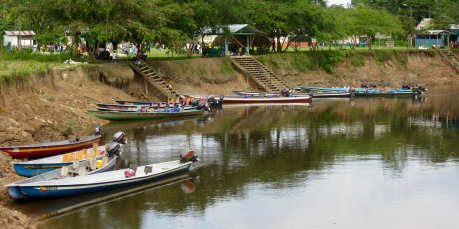
Puerto Bolívar

Puerto Bolívar

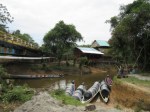
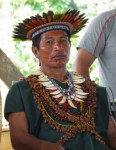
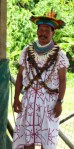
Towards the end of my stay, on a Saturday both bright and hot, the guests of Jamu Lodge and the nearby lodges were invited to attend a once-yearly celebration downriver at the Siona community of Puerto Bolívar.

The Siona, the Cofan, the Secoya and other indigenous peoples populate Amazonia. The Cuyabeno reserve is operated by a collective primarily made up of Siona and Cofan, with the latter group also extending into Colombia. The collective puts up pieces of the reserve for bid to outsiders and this is how Jamu Lodge came to be. Jamu, now 15 years old, and the other lodges lease the land they are on and adhere to the guidelines formulated by the collective.

The guidelines dictate how many lodges the reserve can sustain, how many guests the reserve will receive, and how the lodges care for the environment. Jamu has been in the forefront of the “green” movement within this jungle environment and relies solely on electricity generated from solar panels to operate day-to-day activities.

After some pointed questions about their “green” claim, I was invited to inspect their composting system, the solar charging station, the water filtration units, and the bio-digester for black-water (the plumbing kind of black water, not the tannin-based kind). They really do have a green system. If someone wanted to build a new lodge there on the Cuyabeno, using Jamu as a model would be a smart choice.

But the problem I saw was not with Jamu’s environmental footprint, but rather with the manner in which it handles the interaction between us tourists and the folks downriver. We had been invited to come and share with the Siona and join in, not only at the huge community feast, but also to afterwards take part in the festivities and games of skill, like tree-climbing and spear-throwing, swimming and dancing, chicha-drinking and running. I was ready.

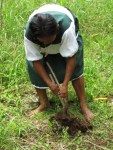
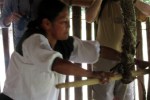
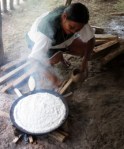
So we left right after breakfast and motored downstream until we landed in Puerto Bolívar around 11am. Sulema had arranged for us to first visit with a family that she’s known for years. The the mother, señora Florinda, showed us how to harvest yucca, peel it, grate it (watch the fingers!), strain it and then cook it on a ceramic griddle for a surprisingly tasty (nothing added) tortilla-like flatbread.

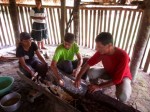
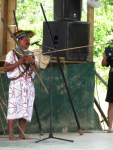
Later we went down to the community hall and listened to several elders. They explained how, in the past, they used bows and 7-ft long arrows to fish. The elders showed us how the blow-gun was made and used, with darts soaked in varying strengths of curare, depending on whether you wanted the animal for food or just to knock it out and keep it as a pet; all fascinating stuff. Then it was time to eat. And so we ate and then just picked up and left.
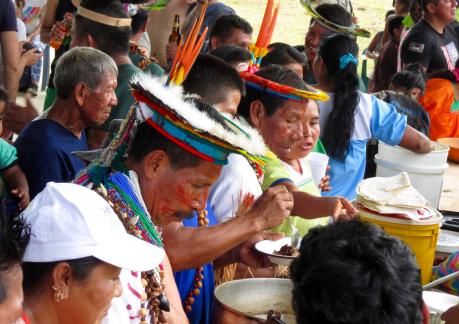
Lovin that Monkey Meat

Lovin that Monkey Meat

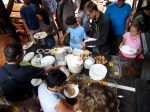
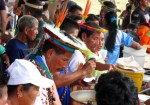
As the communal dishes were being set out for a crowd of several hundred I wandered down the tables seeing what I could see, and then seeing more than I wanted. Halfway down the 50-ft long foodline I spotted one of the main dishes and a human-like claw on one of the platters. I had read that folks still eat monkey and I had also read that it should be refused since primates the world over are endangered. I was so glad that Sulema had brought Lodge-made boxed lunches.

What didn’t make me happy was that immediately after our private meal (off to the side and separate from the foodline), we collected the containers, walked back to the canoe and motored back to the lodge. This was disturbing to me. And I let it be known to Sulema and Victor, the head guide. From all I’ve come across and all I’ve seen personally, no one eats and runs, that’s one of the biggest insults imaginable. The answer I received was as vapid as could be.

They “explained” to me that, well, the Siona aren’t very organized. What??! So, you insult them? I’m still trying to figure out just what transpired, but disorganization is not at its root. These folks, the Siona, host the lodges who in turn host us tourists. Why visit, eat, and then vanish? WTF, indeed.

I understand that they live simpler lives. Puerto Bolívar is miles and hours from the nearest road. Their electricity comes from a diesel-powered generator.  Although earlier I had seen a Siona teen teardown and reconstruct a Yamaha 40hp outboard motor. I lead a simpler life than that kid.

But if they lead simpler lives, isn’t it the responsibility of the lodges, depending on the indigenous community for their existence, to help organize a once-yearly event so that there can be real interaction between the tourists and the people who have lived there for millennia? And wouldn’t this organization of efforts give both groups, the indigenous and us, the chance for interchange? To the benefit of all? Jeez Louise.

Based on previous personal experiences contacting indigenous life and customs here in Ecuador, I know that outsiders want more and deeper opportunities for cultural exchange. And after my encounters with the Shuar down south, I realize that the indigenous also want this exchange because it may be their last, best hope of preserving what they have left.
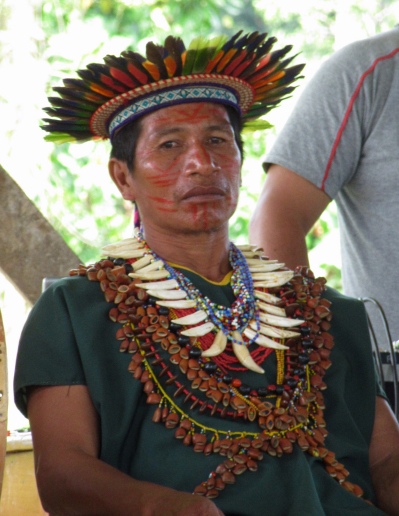
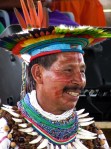
Siona Elder2

Siona Elder2

Earlier, in a completely separate post, I mentioned about the violent confrontations the indigenous have recently had with the Correa government. They do not have a receptive ear within that government and they are desperately looking for other means to get their message to the rest of the world. Here, on the Rio Cuyabeno, they still have that chance.

I came away with feelings of embarrassment (to be included in such an insult), anger (at such insensibility) and confusion (my normal state). Since the visit I’ve communicated with both the lodge and the owner, a Quito-based entrepreneur. Or, I should say that I’ve written to both but not heard back from either.

So, given this lack of perfection, would I repeat my jungle experience again? In a heartbeat. The Amazon Basin is 7 Wonders of the World rolled into one majestic piece of the planet and it deserves to be seen by all who can do so. I would also repeat my stay at Jamu Lodge, which offers both a most restful hideaway and a stimulating chance to be off the grid and unconnected; with some wildlife thrown in to boot.

If I were to repeat this trip, I’d save even more money by flying (or taking a 10-hr bus ride from Quito) to Lago Agrio. Then I’d stop in one of the local agencies and book passage to the Lodge from there. Now that you know it, start planning your trip. Below is a repeat of the images from the first part of this story.

In the Galapagos and Thinking About the Amazon

I’m sitting in the Hostal Gardner here in Puerto Ayora, Galapagos waiting for the Steelers-Pats game. It’s already over (it happened last night) and either Rothlisberger has prevailed or Brady has yet again displayed super-human abilities. Or maybe both. But I don’t know who came out on top and ESPN3/Español will, through pre-recorded programming, lead me to NFL nirvana. It’s still 8 hours until the broadcast, so what to do?

It’s surprisingly cool today, 10 feet above sea level and a few miles south of the Equator. The proprietress of the hostal, Janina, has invited me to take a trip to the highlands of this island to view giant land tortoises, see 2 collapsed craters, and walk through some lava tubes. Her recently married cousin, the cousin’s husband, and Janina’s boyfriend will be going with us too. This should eat up some time before kickoff.

I’d also like to review the jungle trip that I took last month. But I saw so much and La Amazonia is such a critically important region of the world that I’m going to split my account into 2 postings. I’m also going to post more images to go along with the postings, since this was a visual journey. WordPress, the group that hosts my blog, has a feature called a photo-carrousel, so I’m going to try that out too. Let’s see how this works; in Spanish: ¡Vamos a Ver, Compañeros!

I had decided to follow my nose and hook up with a place called Jamu Lodge. It’s located on the right bank of the Rio Cuyabeno, one of the major tributaries in Ecuador leading down to the Amazon River. Though I didn’t know it when I signed up, I later learned that the Cuyabeno is a “black-water” river, fully saturated with tannins from trees growing in the surrounding forests.

These tannins not only stain stain the water dark but they also lower the pH to around 5.4, which makes for an acidic environment. It also means NO MOSQUITOS! It’s hard to believe that one can visit the Amazon basin and not be eaten alive by these parasites, but sadly (not!) this was the case.

After a 7hr overnight bus ride from La Mariscal in Quito I found myself at dawn in Lago Agrio. This is an oil-drillers town hard up against the Colombian border (across the Rio Putumayo) and reputed to frequently host visiting FARC guerrillas on their best behavior. Well, I didn’t see any.

An Interesting pair of bluejeans in Lago Agrio

An Interesting pair of bluejeans in Lago Agrio

But I did have breakfast at Hostal D’Mario while waiting for another bus which would take us to the end of the road. In the meantime I was entertained by a vendor selling medicinal tonics. These folks with their pushcarts are fairly common in cities and towns throughout Ecuador. Here in Lago Agrio this young lady was pouring liquified herbs from jug to jar to jug to jar with a brilliantly choreographed style. And her bluejeans were one-of-a-kind.

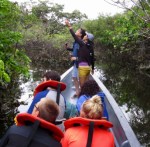
Finally by mid-morning this other, much smaller van showed up. The driver stuffed me and nearly a dozen fellow trippers inside and we took off. I was surrounded by Germans, Dutch, Belgians, a Scotsman and his French wife. Except for the Scotsman they all spoke passable English. We had 2 more hours of sitting in the van until we ran out of pavement and boarded a long canoa for yet another pair of hours motoring down the Cuyabeno to the lodge. By this time I was done with sitting for the day. Or so I thought.

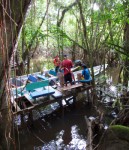
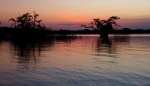
After an hour or so of unpacking, introducing ourselves and settling in, we gathered back at the dock to go up the river for a sunset swim in huge lake formed by the Cuyabeno. Since by then I’d already been back in Quito for a month, wearing layers of fleece for the ever changing high-elevation climate of the capital, it was downright paradisiacal to be clad only in a bathing suit floating, splashing, blowing bubbles and stroking around the boat while watching a beautiful sunset in one direction and a moonrise in the other. I haven’t been to heaven yet but if it’s anything like swimming in that lake at sunset, I’ll be knocking on its door.

The real wonder though, was that this was the first of successive evenings that we spent swimming at sunset. And as the moon was on the wax, each night was more stunning than the night before. After several of these swims we stayed out late for either a nighttime walk through the forest or we floated down the river spotting caimans or a tree boa or we were enchanted by the hundreds of fisher bats, the largest of the bats in Cuyabeno Reserve, swooping down to the water for a night’s feast of small fish.

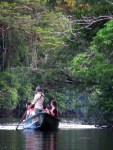
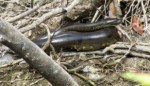
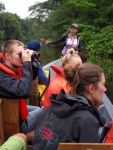
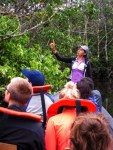
By day we also traveled either up the river or down it or on one of the feeder streams with our guide Sulema. She was a fantastic set of eyes for us, motioning the motorman to halt the canoe countless numbers of times as she spotted monkeys or birds or sleeping bats, plus 1/2 dozen anacondas throughout the week. I knew through readings that this part of Ecuador has some of the highest concentrations of wildlife in the world. But to be there, on the water, and witness this abundance is a spellbinding experience.

A day-walk through the forest is a great example of our time there. We were sloshing (knee-high Wellington boots are the only way to do this) up a trail when Sulema stopped at one of the trees. It could have been any tree as far as I could tell, there were so many of them. Some scientists argue that this portion of the rainforest contains more vegetation per square foot than any other spot on earth. I surely won’t contest that point of view.

As it happens she stood in front of a cinchona tree, where quinine comes from. She explained how the bark is stripped, then dried to a powder and used as an anti-malarial medicine. This bark, in powdered form, was the basis for Samuel Hahnemann’s development of homeopathy for treating diseases. Here, growing wild in the rainforest, it seemed to me like just another tree. Who knew? It turns out many, and for thousands of years in the Quechua culture.

After much oohing and aahing from her charges Sulema then proceeded to blow our minds. In a fold in the bark of the cinchona, known as quina locally,  she pointed out what appeared to be a sleeping beetle about 2 inches long. She ordered each of us to get close enough to see a tiny thread with a white dot protruding from the head of the bug. This insect wasn’t sleeping, it was dead.

And the dot on the filament were spores of a microscopic fungus the beetle had ingested. The fungus feeds on the brains of this and other insects. She explained that eventually the fungus causes the insects to act like zombies and find protected locales for their final resting places. To complete its cycle the fungus bores through the head of the bug and the spores on the end of the stalk are released into the atmosphere to find new hosts. How’s that for nightmares?

I noticed that several of the group seemed to be trying to hold their breaths until she said that this fungus was very specific to insects. The collective sigh was short-lived though when she continued by saying that there were literally thousands of different kinds of air borne fungi like that and we were breathing them in all the time. Sleep well tonight will you? Actually, I did.

Potoo

Potoo

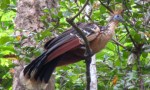
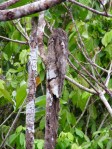
The next morning we were up before dawn engaged in a bird-watching venture, floating among the semi-submerged trees and looking for avians just stirring. While we saw many “Stinking Turkeys,” or Hoatzin which are the most common bird seen in the Cuyabeno, the Potoo was the fascinating one for me. It is one of the few nocturnal birds in the reserve and it took me a good 5 minutes to finally see one while Sulema patiently waited for these old eyes to figure out what to look for. During the day they perch with their beaks pointed skyward and freeze in that posture, becoming (truly) one with the tree. I was pretty excited about this one. You really have to watch this video:

https://youtu.be/ZtjFG16ADZQ?t=1s

For my part the image that I grabbed was of a Potoo perched about 5-6’ above the water on a branch of a dead tree, their favorite hangouts. (On my Mac, if I double-click on the image and then click again on the enlargement, I can then see the bird. Give it a try.)

After finally identifying this bird I came to realize that it was impossible for an outsider to “know” the Amazon even in several lifetimes. Sulema was showing us the easy stuff, animals large enough or common enough for even us lumbering, loud, and camera-flashing tourists to see. And to know that we were only scratching the surface of the abundance of life here is a very humbling realization. But you take what you can get and what we got was a lot, so we continued on.

One of my hopes while in the reserve was to finally see monkeys in the wild. When I was in Guayaquil I took a guided day-trip to Manglares Churute, a vast mangrove reserve and we hoped to catch a glimpse of howler monkeys, the largest in this part of the world.

But a rambunctious group of teens had proceeded us on the path half an hour before, both laughing and chasing the monkeys deeper into the forest with their noise. Though I fully enjoyed myself (except for the snake encounter), I really was disappointed that we could only hear them and occasionally see a shadow or two.

Fortunately the Cuyabeno, and more specifically Sulema, didn’t let us down in this respect either. Of the 9 or so species of monkey in the reserve, we were able to spot 6, including the tiniest, the Pocket Marmoset, smaller than my hand. We saw the Wooly Monkey, with a tail as bushy as a raccoon’s but twice as long as the entire raccoon. We saw White-faced Marmosets and a few others of the marmoset family but I’ve forgotten their names.

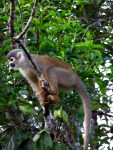
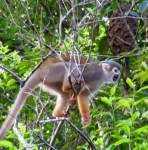
Yet the real stars in the region are the Spider Monkeys, flitting through the trees in tribes of many dozens of animals at a time and not too worried about human trespassers. While we didn’t have the good fortune of 2 other groups at the lodge, where the monkeys actually came down to just a few feet from their canoes, I had my needs met to be sure.

In the tea caddy

In the tea caddy

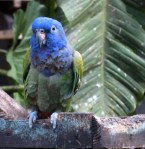
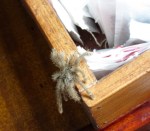
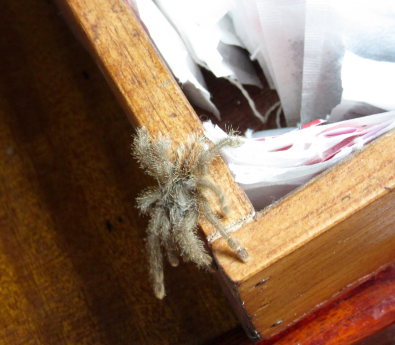
Tarantulas, and scads of other spiders as well, were pretty common near the lodge. And we even had a juvenile who made itself at home in the tea caddy. Each night and on the same tree there were 2 trophy specimens that lumbered slowly on, in search of smaller prey. The lodge also hosted a mild tempered parrot (loro, in Spanish) who often decided to perch on a guest and tour the facilities.

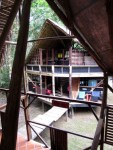
Of the lodge itself, nothing could be found amiss. From the mosquito netting covering each bed that prevented intruders from disturbing our sleep, to the inexhaustible and delicious food for each meal, to the friendly and attentive staff, this was the way to see the Amazon Basin. Elías, the head waiter, could give the best of English butlers a run for their money in his unobtrusive yet excellent and cordial way of anticipating every need. We were living the life.

So with that, I’m going to end part one here.

Not All Volcanoes are Geologic

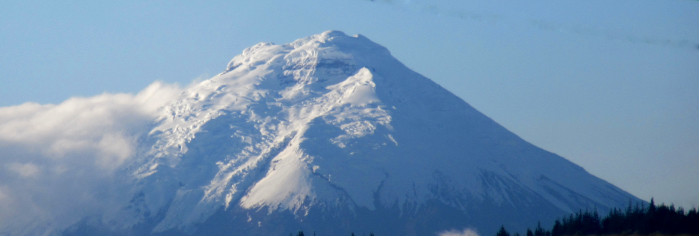
Cotopaxi from Quito

Cotopaxi from Quito

Ecuador endured 2 very different eruptions on the same day this past month. The first was geologic and the second was societal. And both left scars.

On August 14th the world learned that Cotopaxi, 30 miles south of Quito, had erupted once again. One of the tallest, most picturesque, and one of the most dangerous volcanoes in the world, it is readily visible from here in the capital on clear days. After months of ground swells along the flanks and mild tremblors from within the crater, the volcano sent an ash cloud skyward that inflamed our eyes.

Cotopaxi is an important spiritual center for many people in Ecuador. The Quechua, who inhabit the Andes not only in Ecuador but also the other countries making up the spine of South America, regard the mountain as the “Sender of Rain.” Until it became a national park with attendant admission fees, the volcano was the site of regular pilgrimages. Now, though not visited by large numbers of Quechua as before, it is still regarded as sacred. So when it did erupt, they were listening.

But the volcano was not the only disturbance in the country that day. Here in Quito indigenous people met barricades and tear gas. This second eruption though did not register on the Richter Scale, nor did it capture the attention of many beyond Ecuador’s borders. Yet this eruption was felt around the country and even as it is repressed here in Quito it continues in other towns and cities in all parts of Ecuador.    

Both of these tectonic disturbances, Cotopaxi and the people’s riots, elicited immediate and far-reaching actions from Rafael Correa, the President of Ecuador. And he has used Cotopaxi as a reason to declare a state of emergency with a clampdown on the media “to discourage false rumors.”

One month earlier, during mid-July and in the southern province of Zamora Chinchipe, a small but swelling group of indigenous collectives began their long march north. Their plans were to join other indigenous groups from south and central Ecuador and meet in Cuenca, long a center of anti-Correa sentiment. Their ultimate goal was to reach Quito on August 13th and present the government with ultimatums from his voting base.

The president’s rise to power and his subsequent re-election were both due to a large extent from strong backing by the indigenous segment of the population. Historically, once he entered politics he had capitalized on the country’s endemic marginalization of the indigenous way of life. While more than 70% of the country’s population is of mestizo heritage, the old ways had always been seen as 2nd class and therefore unfit for the modern world.

Correa defied this old-guard attitude and argued successfully for the inclusion of traditional beliefs and even changed the constitution to reflect a new reverence for nature and those who are guided by it. His courts allowed Pachamama (mother earth) to bring suit against environmental violators and he gained a great deal of world-wide approval for such enlightened regard for this view of the country and by extension, the planet. Sadly, this enlightenment was not to last.

Declaring that it was foolish for a pauper to be sitting on a bag of gold, Correa, in his second term in office, began instituting changes in policy that are now viewed as inimical to Pachamama. The biggest of these changes involved treaties he has made for extractive rights given to the Chinese. New mineral rights contracts allowing for gold and other precious metals mining on indigenous lands now threaten the existence of the lives and lifestyles of the very people who elected him. They are not happy.

https://youtu.be/exdhIw4KpPY

The above video was recorded by John Caselli, the director of SAEX/Quito. John’s an ex-Marine who served (combat) in Viet Nam and never ran from a fight. Thanks for the permission to use it, John.

But since the Cotopaxi eruption allowed Correa to declare a national emergency with the subsequent media clampdown (already one of the most repressive in South America), Pachamama has worked in his favor. At this point he is safely in office and his party holds an overwhelming majority in congress. It is widely believed that this formula will allow a change in the constitution, removing term limits and setting up a move to see him re-elected as often as he likes. The vote on revising term limits comes up early in 2016.

In 2 days I fly to the Galapagos Islands, where I’ll be schmoozing with the sealions, the tortoises, the iguanas, and laughing at the blue-footed boobies. I’ll be there for 15 days, arranging day-trips out from the capital, Puerto Ayora. After that I return to Quito, pack my bags and say good-bye to Ecuador by flying to Lima, Perú, my new home. I picked a fine time for leaving, Lucille.